Enhancing Lyα Emitter Identification in HETDEX with a Convolutional Neural Network

Enhancing Lyα Emitter Identification in HETDEX with a Convolutional Neural Network
Shiro Mukae, Erin Mentuch Cooper, Karl Gebhardt, Dustin Davis, Lindsay R. House, Mahdi Qezlou, Julian B. Muñoz, Shun Saito, Daniel J. Farrow, Caryl Gronwall, Donald P. Schneider, Eric Gawiser
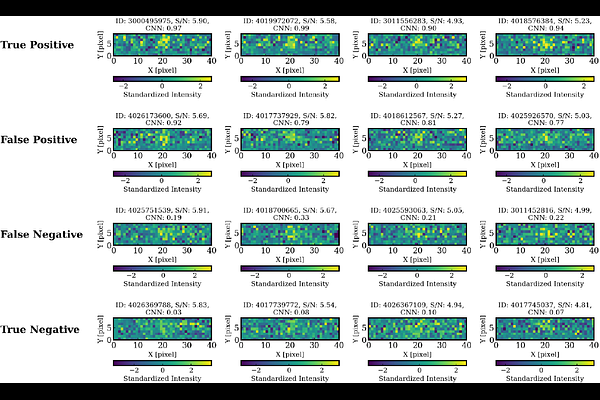
AbstractWe present a deep learning framework to enhance the identification of Ly$α$ emitters (LAEs) in the Hobby-Eberly Telescope Dark Energy Experiment (HETDEX), an untargeted spectroscopic survey of LAEs at $1.9 < z < 3.5$ without imaging pre-selection. We primarily address the low signal-to-noise ratio (S/N) regime ($4.8 \leq \mathrm{S/N} \leq 5.5$), where LAE candidates suffer from substantial noise contamination. To distinguish LAE candidates from artifacts and sky residuals, we employ a convolutional neural network (CNN) trained on two-dimensional spectral images of single emission lines. The training sample is constructed from the HETDEX COSMOS catalog, with external validation from ancillary observations and our participatory science project, \textit{Dark Energy Explorers}. For small-format, low-resolution spectroscopic data, the model achieves a balanced accuracy, precision, and recall of $94.1\%$, $97.5\%$, and $97.5\%$, respectively, in the high-S/N regime ($\mathrm{S/N}>5.5$), and $85.1\%$, $78.2\%$, and $84.4\%$ in the low-S/N regime. Using HETDEX LAEs independently identified by DESI spectroscopy, the model recovers $99\%$ and $93\%$ of the high- and low-S/N LAEs, respectively. Visual attribution indicates that the CNN attends to smooth, spatially extended central emission in true positives and to irregular or noisy features in true negatives. Applied to the full HETDEX catalog, the CNN enables an S/N threshold down to 4.8 by suppressing spurious spikes across $z\sim 1.9$--$2.5$ in the redshift distribution. Our approach facilitates HETDEX cosmological analyses by mitigating false positives in galaxy clustering and highlights the value of domain-specific deep learning for refining low-S/N spectroscopic identification in untargeted surveys.