Spectral Surgery: Training-Free Refinement of LoRA via Gradient-Guided Singular Value Reweighting

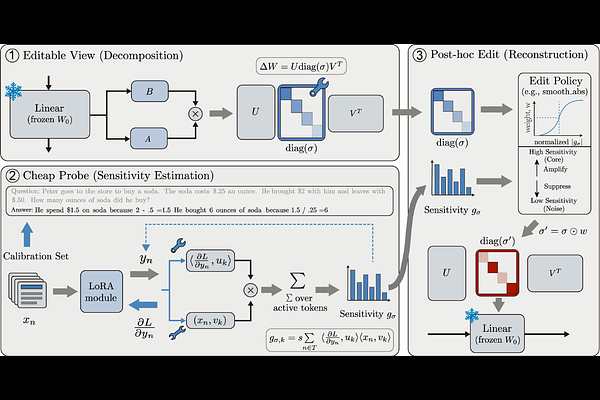
Spectral Surgery: Training-Free Refinement of LoRA via Gradient-Guided Singular Value Reweighting
Zailong Tian, Yanzhe Chen, Zhuoheng Han, Lizi Liao
AbstractLow-Rank Adaptation (LoRA) improves downstream performance by restricting task updates to a low-rank parameter subspace, yet how this limited capacity is allocated within a trained adapter remains unclear. Through a geometric and empirical study across multiple tasks and backbones, we find that trained LoRA updates often exhibit an inefficient spectrum: task effects concentrate in a small subset of singular directions, while many remaining components are neutral or detrimental, motivating post-hoc refinement within the learned subspace. We propose Spectral Surgery, a training-free refinement that decomposes a LoRA update with SVD, estimates per-component sensitivity using gradients on a small calibration set, and reweights singular values under a magnitude constraint while keeping the learned directions fixed. Across Llama-3.1-8B and Qwen3-8B on four benchmarks, Spectral Surgery yields consistent gains (up to +4.4 points on CommonsenseQA and +2.4 pass@1 on HumanEval) by adjusting only $\approx 1{,}000$ scalar coefficients. These results demonstrate that SVD-structured, low-cost parameter editing can serve as a practical route to improving trained LoRA adapters in a purely post-hoc manner.