J-PAS: unprecedented precision in stellar populations of diffuse tidal features

J-PAS: unprecedented precision in stellar populations of diffuse tidal features
Sepideh Eskandarlou, Mohammad Akhlaghi, Francisco Arizo-Borillo, Johan H. Knapen, Helena Domínguez Sánchez, Juan Antonio Fernández-Ontiveros, Carlos López-Sanjuan, Rosa María González Delgado, Yolanda Jiménez Teja, Renato Dupke, Yves Revaz, Pascale Jablonka, Santi Roca-Fábrega, Juan Miró-Carretero, David Martínez-Delgado, Alejandro Lumbreras-Calle, Antonio Hernán-Caballero, Héctor Vázquez Ramió, Raúl Infante-Sainz, Ana L. Chies-Santos, Alessandro Ederoclite, Julio Esteban Rodríguez Martín, Raul Abramo, Jailson Alcaniz, Narciso Benitez, Silvia Bonoli, Javier Zaragoza, Saulo Carneiro, Javier Cenarro, David Cristóbal-Hornillos, Simone Daflon, Carlos Hernández-Monteagudo, Jifeng Liu, Antonio Marín Franch, Claudia Mendes de Oliveira, Mariano Moles, Fernando Roig, Laerte Sodré, Keith Taylor, Jesús Varela, José Manuel Vilchez
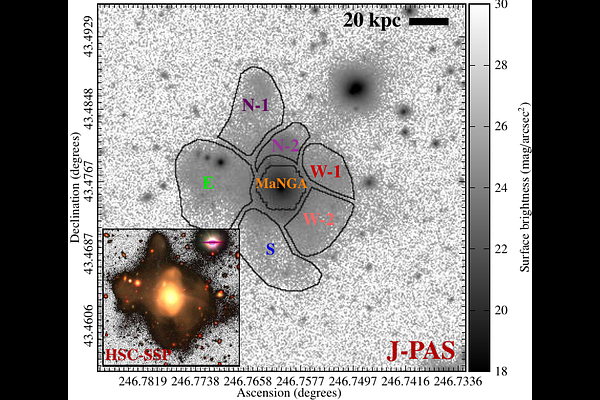
AbstractGalaxies frequently interact with nearby systems, a process that can significantly alter their morphology and star formation activity. However, spectroscopic studies of their faint and diffuse remnants require very long exposure times and often exceed the limited field of view of integral field units (IFUs). On the other hand, broad-band imaging can have a much wider field of view, but lacks the spectral resolution to identify key spectral features, restricting accurate constraints on stellar population properties. With its 54 narrow-band filters in the optical and wide coverage (planned 8000 square degrees), J-PAS fills this gap. In this case study, we examine PGC 3087775, a massive galaxy at z = 0.046179 (~ 201 Mpc) in the later stages of a major merger in the J-PAS early data release. Photometry was validated with MaNGA IFU data (for the central part). Stellar population properties was derived using both J-PAS and SDSS photometry. SDSS indicates a metal-rich population with an extended star formation history (SFH) and elevated star formation rates. J-PAS instead points to a less metal-rich population with moderate extinction and a more rapid SFH, consistent with a quenched stellar population. The average Dn(4000) index of the tidal features is 1.24, suggesting that it was a non-dry merger and a fourfold improvement in the precision of stellar mass and Dn (4000) was found with J-PAS. We also assessed two heuristic methods for estimating the mass-to-light ratio from SDSS filters and found that they overestimate the stellar mass in this galaxy by 0.5 dex and 0.4 dex relative to SED fitting results from J-PAS and SDSS, respectively. Future work will extend this analysis to a larger sample of merging galaxies and evolution of the stellar populations of such structures across the nearby Universe to unprecedented detail. This project is fully reproducible, through Maneage (commit 0f0d7e2).