Sample-Based Quantum Diagonalization with Amplitude Amplification

Sample-Based Quantum Diagonalization with Amplitude Amplification
Nina Stockinger, Ludwig Nützel, Michael J. Hartmann
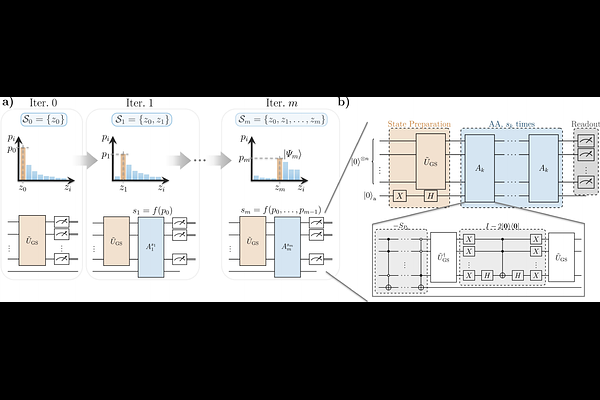
AbstractRecently, sample-based quantum diagonalization (SQD) has emerged as a promising approach to compute ground and excited states of problem Hamiltonians.This method classically diagonalizes a Hamiltonian in a subspace that is spanned by samples obtained from a quantum computer. However, by its nature, SQD suffers from a fundamental sampling problem, as some basis states that are required for a targeted accuracy may only be sampled extremely rarely. To alleviate this limitation, we introduce the SQD-AA algorithm that combines SQD with amplitude amplification (AA). SQD-AA uses AA to sequentially reduce probabilities of already measured bitstrings, thus making the observation of new ones more likely. We observe a reduction in the total query complexity of more than a factor 100 for algebraically and exponentially decaying model distributions, and analytically show a quadratic advantage for the latter. Moreover, we evaluate real molecules in an early fault-tolerant scenario and compare SQD-AA to SQD and iterative quantum phase estimation (iQPE). For all considered examples, we observe the lowest total number of T-gates for SQD-AA while only requiring circuits that are 3-4 orders of magnitude shallower than those needed for iQPE. Given this substantial reduction in circuit depth compared to iQPE while saving 2 orders of magnitude in total runtime compared to SQD, we expect a significant regime in early fault-tolerance where SQD-AA runs feasibly, but iQPE circuits are too deep to execute confidently.