The Evolution of X-ray Spectra in Tidal Disruption Events

The Evolution of X-ray Spectra in Tidal Disruption Events
Wei Chen, Erlin Qiao
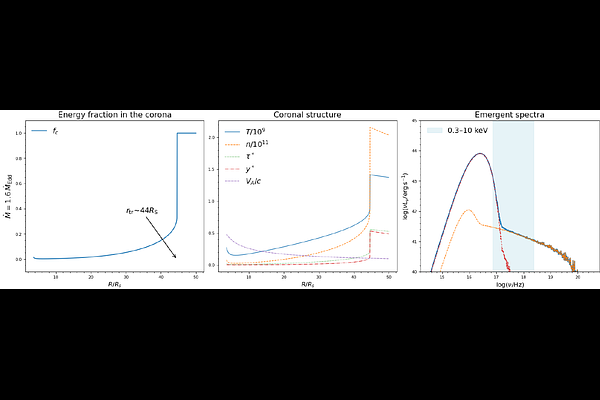
AbstractThe study of the evolution of X-ray spectra in tidal disruption events (TDEs) is an important approach for understanding the physical processes occurring near a supermassive black hole. Observations show that the X-ray spectra of TDEs are very soft at the peak after the outburst, followed by a spectral hardening on a timescale of years. Theoretically, TDEs are suggested to undergo super-Eddington accretion around the time of the outburst. In this paper, we construct a new disc-corona model to explain the observed X-ray spectral hardening in TDEs. In our model, there is a transition radius \(r_{\rm tr}\). For \(r < r_{\rm tr}\), the accretion flow exists in the form of a slim disc, whose emission is dominated by soft X-rays. For \(r > r_{\rm tr}\), the accretion flow exists in the form of a traditional sandwiched disc-corona, in which a harder X-ray spectrum is produced. Our calculations show that \(r_{\rm tr}\) decreases with decreasing mass accretion rate \(\dot{M}\), which naturally predicts the hardening of the X-ray spectra since the relative contribution of the outer disc-corona to the inner slim disc increases as \(\dot{M}\) decreases. Our model has been applied to explain the observed X-ray spectral hardening in the TDE candidate AT 2019azh, in which \(\dot{M}\) is assumed to decrease proportionally to \(t^{-5/3}\). Potential applications of the model for explaining the X-ray spectral evolution in upcoming rich TDE observations are also expected.