LongCat-Flash-Prover: Advancing Native Formal Reasoning via Agentic Tool-Integrated Reinforcement Learning

LongCat-Flash-Prover: Advancing Native Formal Reasoning via Agentic Tool-Integrated Reinforcement Learning
Jianing Wang, Jianfei Zhang, Qi Guo, Linsen Guo, Rumei Li, Chao Zhang, Chong Peng, Cunguang Wang, Dengchang Zhao, Jiarong Shi, Jingang Wang, Liulin Feng, Mengxia Shen, Qi Li, Shengnan An, Shun Wang, Wei Shi, Xiangyu Xi, Xiaoyu Li, Xuezhi Cao, Yi Lu, Yunke Zhao, Zhengyu Chen, Zhimin Lin, Wei Wang, Peng Pei, Xunliang Cai
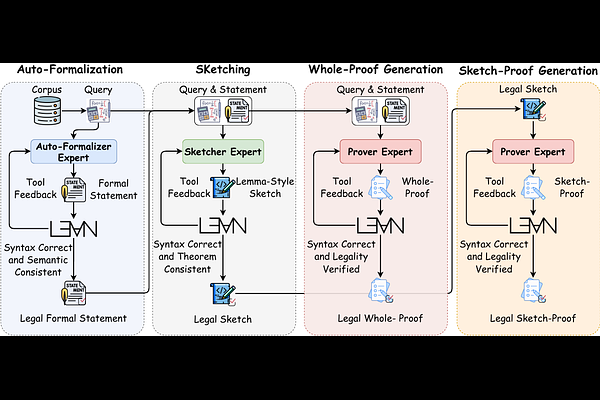
AbstractWe introduce LongCat-Flash-Prover, a flagship 560-billion-parameter open-source Mixture-of- Experts (MoE) model that advances Native Formal Reasoning in Lean4 through agentic tool-integrated reasoning (TIR). We decompose the native formal reasoning task into three independent formal capabilities, i.e., auto-formalization, sketching, and proving. To facilitate these capabilities, we propose a Hybrid-Experts Iteration Framework to expand high-quality task trajectories, including generating a formal statement based on a given informal problem, producing a whole-proof directly from the statement, or a lemma-style sketch. During agentic RL, we present a Hierarchical Importance Sampling Policy Optimization (HisPO) algorithm, which aims to stabilize the MoE model training on such long-horizon tasks. It employs a gradient masking strategy that accounts for the policy staleness and the inherent train-inference engine discrepancies at both sequence and token levels. Additionally, we also incorporate theorem consistency and legality detection mechanisms to eliminate reward hacking issues. Extensive evaluations show that our LongCat-Flash-Prover sets a new state-of-the-art for open-weights models in both auto-formalization and theorem proving. Demonstrating remarkable sample efficiency, it achieves a 97.1% pass rate on MiniF2F-Test using only 72 inference budget per problem. On more challenging benchmarks, it solves 70.8% of ProverBench and 41.5% of PutnamBench with no more than 220 attempts per problem, significantly outperforming existing open-weights baselines.