Photometric and late-time spectropolarimetric observations of GRB 250129A afterglow

Photometric and late-time spectropolarimetric observations of GRB 250129A afterglow
A. Ghosh, S. Razzaque, J. Barnard, J. C. Joshi, R. Gupta, D. A. H. Buckley, B. van Soelen, N. Dukiya, A. Gupta, A. S. Moskvitin, J. Cooper, S. Chandra, K. M. Jayasurya, K. Misra, N. Rawat, L. Resmi, O. I. Spiridonova, R. I. Uklein
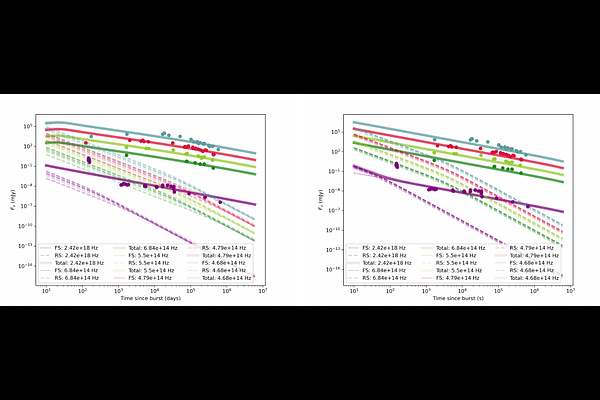
AbstractGamma-Ray Burst (GRB) afterglows arise from the interaction of relativistic ejecta with the circumburst medium and are observed across the electromagnetic spectrum. Afterglow polarisation is expected at early and late phases depending on the presence of reverse shocks (RS) and the observer's viewing geometry relative to the jet. Polarimetric observations of GRB afterglows provide a unique diagnostic tool to probe the geometry and structure of magnetic fields in the emitting region, which cannot be inferred from photometric or spectroscopic data alone. We report late-time (~19 hours post-burst) spectropolarimetric observations of GRB 250129A using the Southern African Large Telescope (SALT). The data reveal a hint of linear polarisation, with no evidence for rotation in the polarisation angle across wavelengths. Polarisation is typically expected during the early afterglow (<100 s) when the RS dominates. However, multi-wavelength modelling shows no indication of RS contribution at late times. Modelling incorporating both forward shock (FS) and RS components confirms that the RS fades rapidly after ~100 s. The afterglow emission is best explained by an off-axis viewing geometry of a jet with a Gaussian core and wings evolving in a uniform density environment. GRB 250129A thus provides rare observational evidence linking late-time polarisation to jet geometry and structure.