The chemical fingerprint of the Gaia BH3 system. Evidence for early cluster enrichment from the analysis of 51 elements

The chemical fingerprint of the Gaia BH3 system. Evidence for early cluster enrichment from the analysis of 51 elements
Gregory Vanden Broeck, Thibault Merle, Nhat Tan Mai, Sophie Van Eck, Stephane Goriely, Lionel Siess, Alain Jorissen, Do Thi Hoai
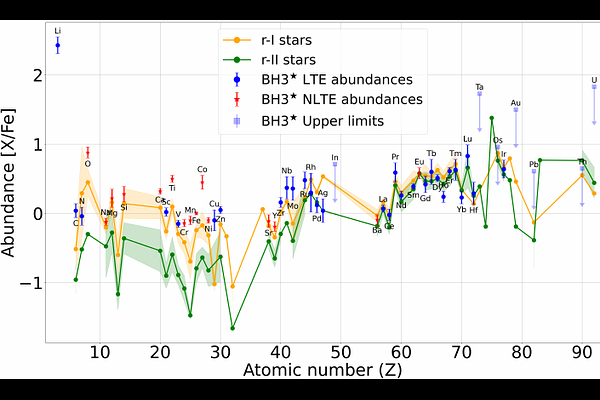
AbstractThe Gaia BH3 system hosts the most massive known stellar-origin black hole and a low-mass metal-poor companion whose chemical composition may constrain early explosive nucleosynthesis processes. We investigate the chemical abundances of the companion in order to constrain the formation of this remarkable system. We perform a detailed analysis of high-resolution ESO-UVES spectra of the companion. 51 elements from lithium to uranium were investigated through spectral synthesis, including 15 treated in NLTE. We compare the resulting pattern to r-process enriched stars, to nucleosynthesis models and to stars of the ED-2 stream. The abundance pattern of the BH3 companion is consistent with that of r-I stars and is well reproduced by a combination of core-collapse supernova yields and an r-process component. The chemical patterns of four ED-2 stars closely match that of the companion especially when a dilution is taken into account. The present analysis provides the most detailed chemical characterisation of a metal-poor star associated with a stellar-mass black hole. The chemical similarity with ED-2 stars argue against local pollution across the binary system. The abundances instead reflect early spatially inhomogeneous enrichment of the progenitor cluster.