The Radio-wave Observations at the Lunar Surface of the photoElectron Sheath (ROLSES) instrument onboard the Intuitive Machines-1 Mission to the Moon

The Radio-wave Observations at the Lunar Surface of the photoElectron Sheath (ROLSES) instrument onboard the Intuitive Machines-1 Mission to the Moon
Nat Gopalswamy, Robert J. MacDowall, Pertti A. Mäkelä, Scott A. Boardsen, Seiji Yashiro, Richard B. Katz, Igor Kleyner, Scott D. Murphy, Richard C. Mills, Chimaobi Onyeachu, Michael K. Choi, Thomas M. Schluszas, Victor Gonzalez-leon, Pietro A. Sparacino, William M. Farrell, Damon C. Bradley, Jack O. Burns, Joshua J. Hibbard
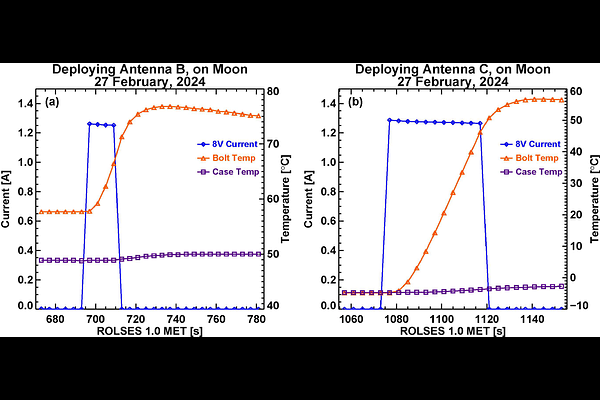
AbstractThe Radio wave Observations at the Lunar Surface of the photoElectron Sheath (ROLSES) instrument is a radio telescope system designed to characterize the radio and plasma wave environment of the nearside lunar surface at frequencies between 2 kHz and 30 MHz. The ROLSES sensor consists of a set of four 2.5 meter radio monopole antennas onboard the Intuitive Machines (IM 1) lander, Odysseus. The antennas were stowed during launch and deployed after landing on the lunar surface using a frangibolt mechanism. The frequency range is well suited to observing radio waves at frequencies below 15 MHz that cannot be observed from Earth due to the ionospheric cutoff. Radio waves from the Sun, the Milky Way galaxy, Jupiter, Earth's auroral region, and ground-based radio transmitters were expected to be present on the lunar surface. Radio data from each of the 4 antennas, after passing through an isolating pre-amp and signal conditioning analog electronics, were digitized to 14 bits at 120 mega samples per second and then digitally processed by a Field Programmable Gate Array (FPGA) that performs onboard spectral analysis via a Fast Fourier Transform (FFT). Time averaged spectral values are then stored and returned. Also telemetered to Earth are raw waveforms (unprocessed time sequence data) that are useful in studying dust impact on ROLSES antennas. ROLSES data are sent to the lander and subsequently downlinked for further processing. ROLSES is part of NASA's Commercial Lunar Payload Services (CLPS) program. Odysseus landed close to the south pole at Malapert A (80 S). This paper describes the design and operations of the ROLSES instrument and presents initial observations made during transit and surface operations in February 2024. We also describe next version of this instrument (ROLSES 2) currently under development.