JWST high-contrast spectroscopy with speckle modelling: Atmospheric retrievals of the T dwarf companion HD 19467 B

JWST high-contrast spectroscopy with speckle modelling: Atmospheric retrievals of the T dwarf companion HD 19467 B
Darío González Picos, Tessa van der Post, Sam de Regt, Jean-Baptiste Ruffio, Natalie Grasser, Ignas Snellen
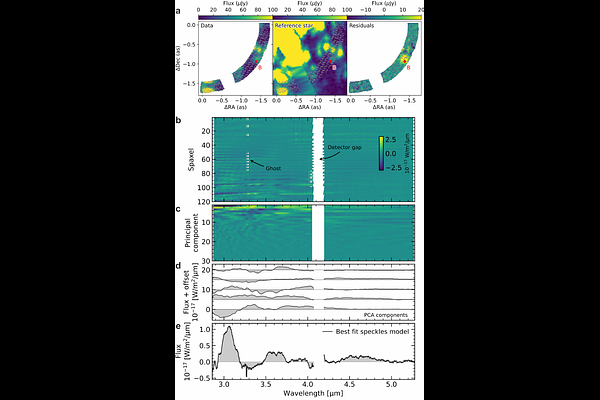
AbstractHigh-contrast, medium-resolution spectroscopy with JWST can resolve molecular and isotopic features in cool substellar atmospheres, but for close-in companions the extracted spectra can be biased by wavelength-dependent residual stellar contamination. We assess the impact of residual speckles on atmospheric inference for the T dwarf companion HD 19467 B and compare the results to the field T dwarf 2MASS J0415-0935. We analyse JWST/NIRSpec G395H spectra ($2.87$--$5.2$$μ$m; $R\sim2700$) and perform Bayesian atmospheric retrievals with petitRADTRANS coupled to nested sampling using ultranest. We use a flexible, parameterised pressure-temperature profile with free, constant-with-altitude molecular abundances. For HD 19467 B we fit the PSF-subtracted spectrum with a linear model that includes the atmospheric model and a set of speckle spectra from the integral field unit. We detect H$_2$O, CH$_4$, CO, CO$_2$, and NH$_3$ in both atmospheres and measure carbon isotopic ratios from CO isotopologues, finding $^{12}$C/$^{13}$C$=154^{+19}_{-17}$ for HD 19467 B and $^{12}$C/$^{13}$C$=85\pm5$ for 2MASS J0415-0935. Speckle contamination primarily affects the low-frequency spectral shape at $3.0$--$3.7$$μ$m and can affect retrieved abundances if not accounted for. We obtain seemingly constrained posteriors for some additional species (e.g.\ SiO and H$_2$S) in some cases, but treat these as tentative because cross-correlation does not yield significant detections; PH$_3$ is not detected in either target. Joint fitting of the atmospheric spectrum and the speckle contamination enables native-resolution retrievals of the high-contrast companion HD 19467 B with JWST/NIRSpec without continuum subtraction. Over $2.87$--$5.2$$μ$m, medium-resolution spectroscopy constrains elemental and isotopic composition; both objects exhibit near-solar metallicity and subsolar C/O ratios.