The Way We Tally Becomes the Tale: the Impact of Selection Strategies on the Inferred Evolution of Little Red Dots Across Cosmic Time

The Way We Tally Becomes the Tale: the Impact of Selection Strategies on the Inferred Evolution of Little Red Dots Across Cosmic Time
Pierluigi Rinaldi, Kevin Hainline, Francesco D'Eugenio, Pablo G. Pérez-González, Daniel J. Eisenstein, Christopher N. A. Willmer, Courtney Carreira, Brant Robertson, Benjamin D. Johnson, Stacey Alberts, William M. Baker, Andrew J. Bunker, Stefano Carniani, Eiichi Egami, Jakob M. Helton, Zhiyuan Ji, Ignas Juodžbalis, Xiaojing Lin, Jianwei Lyu, Zheng Ma, Roberto Maiolino, Eleonora Parlanti, Jan Scholtz, Sandro Tacchella, Giacomo Venturi, Christina C. Williams, Chris Willott, Joris Witstok, Yang Sun, Zihao Wu
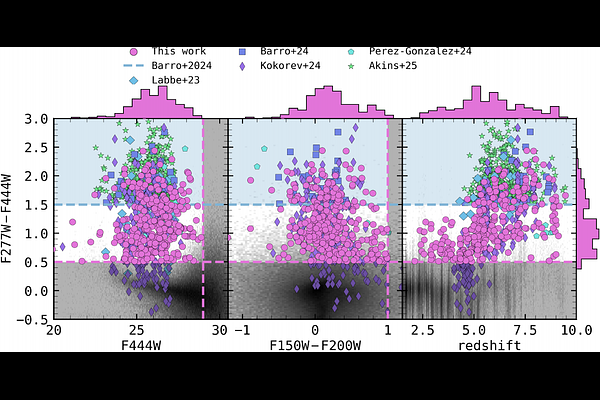
AbstractLittle Red Dots (LRDs) have emerged as a key population linked to early black hole growth, yet photometric selections have predominantly targeted only the most extreme red systems, thereby shaping our current understanding of this new population of objects. In this work, we deliberately explore a broad range of optical redness while enforcing stringent compactness and visual inspection to ensure robustness and minimize contamination. Leveraging the depth and multiwavelength coverage of the JWST Advanced Deep Extragalactic Survey (JADES) data in the GOODS-North and GOODS-South fields, we construct the largest photometric census of LRDs to date in these fields, comprising 412 sources over $z\approx2\text{--}11$ across $\approx349.6$ arcmin$^2$. We show that classic extreme color cuts isolate only a minor fraction of this population ($\lesssim25\%$), while the majority of LRDs span a broader, largely unexplored parameter space. We quantify how selection strategies impact UV and optical luminosity functions and number density evolution, finding that current demographic trends of LRDs are strongly driven by selection biases and further limited by incomplete identification at both high and low redshift. Spectroscopically confirmed LRDs reveal a continuous range of spectral shapes, consistent with varying Active Galactic Nucleus (AGN) and host contributions in agreement with recent findings. Our results demonstrate that commonly adopted, purity-driven selections bias current demographic constraints toward the most extreme systems, potentially misrepresenting the diversity and evolution of the LRD population. Accounting for these selection effects is essential for interpreting LRDs and their role in early black hole growth.