Formation of spirals in early stage protoplanetary discs

Formation of spirals in early stage protoplanetary discs
Marc Van den Bossche, Oliver Gressel
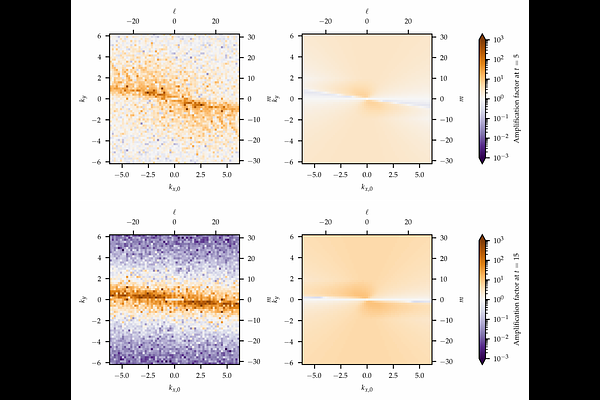
AbstractClass II protoplanetary discs feature numerous non-axisymmetric substructures like spirals and the underlying mechanisms for their formation are still highly debated. Coincidentally, early stage, massive discs are subject to the gravitational instability that causes them to collapse into denser substructures. However, like for most instabilities, real systems usually remain marginally stable, here with Toomre parameter $Q \gtrsim 1$. We study how the self-gravity of the gas triggers the growth of spiral structures in the disc. We specifically focus on discs that are considered stable, that is, with respect to the gravitational instability (with $Q > 1$), as these discs remain unstable to non-axisymmetric perturbations like spirals. After a linear stability analysis, we produce high-resolution 2D shearing sheet simulations with the GPU-accelerated code \idefix of self-gravitating discs. We probe different initial densities and thermodynamical models of Toomre-stable discs. The initial transient growth of the spiral wave matches the linear theory provided we take into account the time dependency of the amplification. The spirals are then rapidly non-linearly amplified with growth rate $\approx 10$ orbital time scale. After this time spiral large scale mode are amplified up to 1000 times more than linear theory predicts. At later times, low density discs reach a weak gravito-turbulent state with $α\approx 10^{-3}$ and discs with higher density undergo runaway collapse of the spiral arms. All discs exhibit dominant large-scale spirals.