TOI-2147 b and TOI-6019 b: Two eccentric warm Jupiters detected and characterized with TESS and MaHPS

TOI-2147 b and TOI-6019 b: Two eccentric warm Jupiters detected and characterized with TESS and MaHPS
Luis Thomas, Louise D. Nielsen, Hanna Kellermann, Bibiana Prinoth, Yutong Liu, Elif Zeynep Özden, Arno Riffeser, Claus Gössl, Frank Grupp, Jerome de Leon, Karen A. Collins, Allyson Bieryla, Lorena Acuña-Aguirre, Keith Baka, Malte Busmann, David R. Ciardi, Catherine A. Clark, Juliana Ehrhardt, Mark E. Everett, Akihiko Fukui, Jan-Vincent Harre, Keisuke Isogai, Felipe Murgas, Norio Narita, Enric Palle, Hannu Parviainen, Jan-Niklas Pippert, Christoph Ries, Boris S. Safonov, Thomas Schäfer, Michael Schmidt, Richard P. Schwarz, Laura Schöller, Gregorg Srdoc, Ivan A. Strakhov, Suzanne Taylor, Raphael Zöller
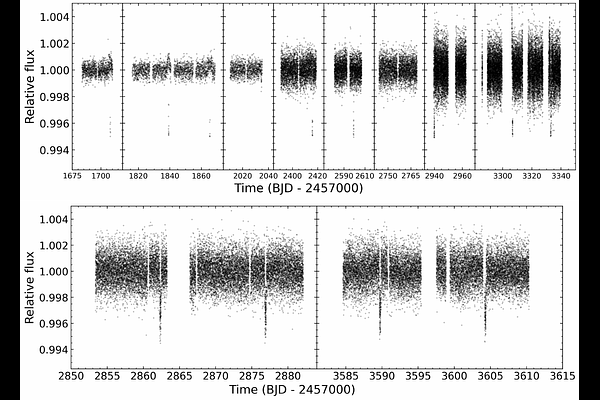
AbstractThe population of Jupiter-sized exoplanets with orbital periods between 10 and 200 days (WJs) exhibits a broad range of orbital eccentricities and system architectures, suggesting a diversity of formation and migration pathways. In this work, we report the detection and characterization of two new eccentric WJs, TOI-2147 b and TOI-6019 b, initially identified as planet candidates by the Transiting Exoplanet Survey Satellite (TESS). We combined TESS photometry with ground-based follow-up observations, including multiband photometry from LCOGT and MuSCAT2, high-angular-resolution speckle imaging, and high-precision radial velocity measurements from the high-resolution Manfred Hirt Planet Finder Spectrograph (MaHPS). Using these data, we were able to confirm the planetary nature of both candidates. TOI-2147 b has a radius of $10.5 \pm 0.3\,\mathrm{R}_\oplus$ and a mass of $116 \pm 22\,\mathrm{M}_\oplus$. It orbits its slightly metal-poor ($\mathrm{[Fe/H]} = -0.29^{+0.07}_{-0.08}$) G-type host star on an eccentric orbit ($e = 0.29 \pm 0.07$) with a period of 26.2 days. TOI-6019 b has a radius of $12.3 \pm 0.3\,\mathrm{R}_\oplus$ and a mass of $149 \pm 15\,\mathrm{M}_\oplus$. It orbits a slightly evolved, solar-metallicity G-type sub-giant with a period of 14.5 days on a significantly eccentric orbit ($e = 0.48^{+0.05}_{-0.04}$). Both planets have bulk densities below that of Jupiter, indicating mildly inflated radii, with interior structure modeling using GASTLI. This suggests that tidal heating from the nonzero eccentricities likely contributes to this inflation and disfavors large atmospheric metal enrichment. No significant signals from additional companions were detected in the radial velocity time series or transit timing variations. Together with the elevated eccentricities, this is consistent with a high-eccentricity migration origin for both systems.