Do little red dots really form a distinct class of astronomical objects?

Do little red dots really form a distinct class of astronomical objects?
Jean-Baptiste Billand, David Elbaz, Maximilien Franco, Fabrizio Gentile, Emanuele Daddi, Mauro Giavalisco, Dale D. Kocevski, Joseph S. W. Lewis, Benjamin Magnelli, Valentina Sangalli, Maxime Tarrasse
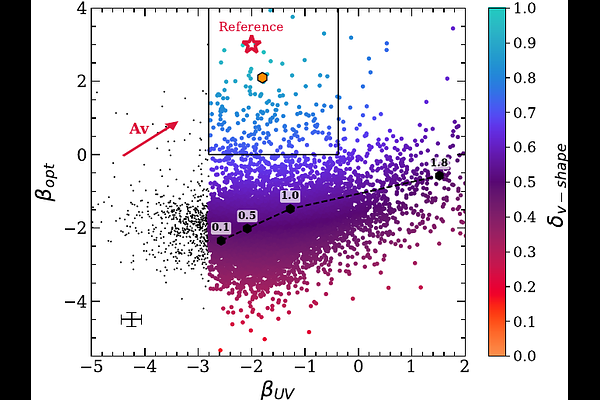
AbstractJWST observations have identified a class of enigmatic sources known as "Little Red Dots" (LRDs). These have been interpreted as a distinct class of active galactic nuclei (AGN) and host galaxies, potentially involving "quasi-stars" or Black Hole stars (BH*). However, two questions remain: is there a clear discontinuity between LRDs and field galaxies, and do LRDs form a homogeneous population? In this work, we address these issues by introducing a continuous metric to evaluate the "LRDness" of galaxies. We measure their compactness ($δ_{compact}$), the sharpness of the V-shaped spectral energy distribution ($δ_{v-shape}$), and the strength of the broad Balmer line emission. We apply this approach to a sample of ~48,000 galaxies with photometric and ~5,000 with spectroscopic information, selected over ~750 arcmin^2. We find that V-shape prominence correlates strongly with morphology without a clear transition at common LRD selection thresholds: the fraction of compact galaxies rises continuously with V-shape intensity. Similarly, broad H$α$ strength increases with both V-shape sharpness and compactness. The [N II] deficit is not an exclusive feature of LRDs but a global property of compact, metal-poor galaxies. Only the 3% most extreme LRDs present a prominent Balmer break (>3) of potentially non-stellar origin. LRDs and non-LRDs follow similar trends in the evolution of the Balmer decrement with V-shape sharpness, suggesting a shared physical origin, likely dust attenuation. Estimated dust masses (~4-7 x 10^4 M_{sun}) and luminosities are low enough to account for their non-detection by ALMA. We conclude that most LRDs do not represent a separate class of objects, but rather the extreme tail of a continuous distribution of galaxies and broad H$α$ emitters, consistent with a classical broad line region and dust attenuation.