From Reachability to Learnability: Geometric Design Principles for Quantum Neural Networks

From Reachability to Learnability: Geometric Design Principles for Quantum Neural Networks
Vishal S. Ngairangbam, Michael Spannowsky
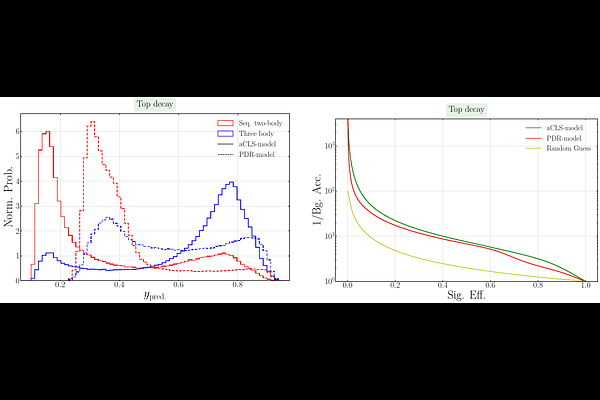
AbstractClassical deep networks are effective because depth enables adaptive geometric deformation of data representations. In quantum neural networks (QNNs), however, depth or state reachability alone does not guarantee this feature-learning capability. We study this question in the pure-state setting by viewing encoded data as an embedded manifold in $\mathbb{C}P^{2^n-1}$ and analysing infinitesimal unitary actions through Lie-algebra directions. We introduce Classical-to-Lie-algebra (CLA) maps and the criterion of almost Complete Local Selectivity (aCLS), which combines directional completeness with data-dependent local selectivity. Within this framework, we show that data-independent trainable unitaries are complete but non-selective, i.e. learnable rigid reorientations, whereas pure data encodings are selective but non-tunable, i.e. fixed deformations. Hence, geometric flexibility requires a non-trivial joint dependence on data and trainable weights. We further show that accessing high-dimensional deformations of many-qubit state manifolds requires parametrised entangling directions; fixed entanglers such as CNOT alone do not provide adaptive geometric control. Numerical examples validate that CLS-satisfying data re-uploading models outperform non-tunable schemes while requiring only a quarter of the gate operations. Thus, the resulting picture reframes QNN design from state reachability to controllable geometry of hidden quantum representations.