Model-Independent Analysis of Type Ia Supernova Datasets and Implications for Dark Energy

Model-Independent Analysis of Type Ia Supernova Datasets and Implications for Dark Energy
Zhenyuan Wang, Yun Wang
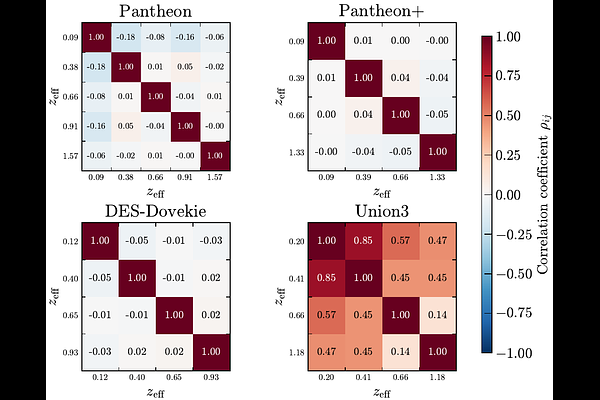
AbstractRecent analyses combining DESI DR2 BAO with CMB and SNe Ia data have reported $2.8$--$4.2σ$ evidence for dynamical dark energy, but the significance depends strongly on the supernova sample, raising the question of whether this signal reflects new physics, dataset-specific systematics, or the choice of dark energy parameterization. We investigate this question by analyzing four SNe Ia compilations (Pantheon, Pantheon+, DES-Dovekie, and Union3) with DESI DR2 BAO and Planck CMB distance priors, using flux averaging, model-independent expansion rate extraction, parametric ($w_0 w_a$CDM) fits, and a non-parametric reconstruction of the dark energy density ratio $X(z) \equiv ρ_{\rm DE}(z)/ρ_{\rm DE}(0)$. Flux averaging reduces the $Ω_m$ difference between SNe and DESI from ${\sim}2σ$ to ${\sim}1σ$ for Pantheon+ and DES-Dovekie. The reconstructed $X(z)$ for DESI DR2 + CMB + SNe is consistent with $Λ$CDM for Pantheon, Pantheon+, and DES-Dovekie except at $0.5<z<1$, consistent with Wang \& Freese (2026). The largest deviation occurs at $z=2/3$, reaching ${\sim}2.7σ$ for Pantheon+ but only $1.6$--$1.7σ$ for Pantheon and DES-Dovekie. The $X(z)$ for DESI DR2 + CMB + Union3 is consistent with these within $1σ$, but shows an additional $2.4σ$ deviation at $z=1/3$ besides the ${\sim}2.7σ$ deviation at $z=2/3$. Across all analyses, the departure from $Λ$CDM correlates with each dataset's $Ω_m$ preference. We demonstrate that a pure $Λ$CDM universe with the measured $Ω_m$ differences can reproduce the observed $X(z)$ pattern, providing a viable alternative interpretation of the observed $X(z) \neq 1$ pattern. Future surveys by Euclid and Roman with sub-percent $Ω_m$ constraints will be essential to determine whether the signal reflects genuine dark energy evolution or residual inter-probe $Ω_m$ inconsistencies.