Mitigating effects of telescope jitter through differentiable forward-modeling

Mitigating effects of telescope jitter through differentiable forward-modeling
Max Charles, Louis Desdoigts, Benjamin Pope, Connor Langford, David Sweeney, Peter Tuthill
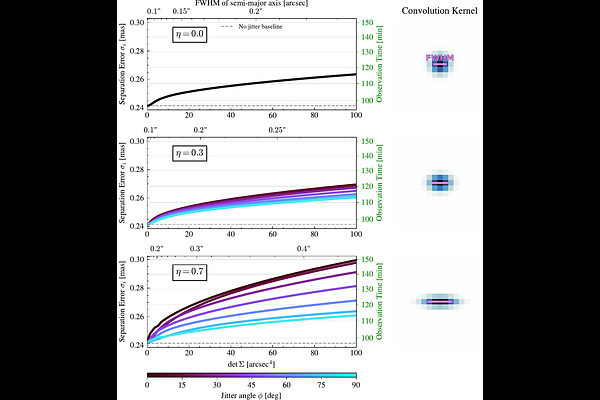
AbstractInstabilities in telescope pointing, commonly referred to as jitter, introduce image degradation that can compromise the accuracy of critical scientific observables. This work presents a differentiable forward-modeling approach to both understand and mitigate the impact of jitter. We apply dLux -- a differentiable optical simulation framework built in the JAX numerical simulation framework -- to model the blurring effects of jitter on the final image. We categorize jitter into low-, medium-, and high-frequency regimes with respect to the camera frame rate and build simple jitter models based on its manifestation on the detector. The forward-model approach proves effective for low- and high-frequency regimes, but the inherent unpredictability of medium-frequency jitter may lead to model misspecification. As a test case we apply these models to the TOLIMAN mission, a forthcoming CubeSat telescope dedicated to detecting nearby Earth-analogue exoplanets through high-precision astrometry. Using Fisher information analysis, we quantify the effect of jitter on TOLIMAN's primary science observable -- the angular binary separation of the Alpha Centauri AB binary components. We find model misspecification does not introduce a systematic bias on the recovered binary separation except when fitting a one-dimensional jitter model to a two-dimensional motion, hence we recommend the use of a two-dimensional model. The forward-model approach offers a generalized method applicable to other telescope systems, including ongoing work with JWST's NIRISS instrument. This approach represents a significant step toward delivering higher accuracy measurements at modern observatories as demands on precision continue to rise.