Anisotropic non-Maxwellian velocity distributions in the solar transition region

Anisotropic non-Maxwellian velocity distributions in the solar transition region
Paola Testa, Bart De Pontieu, Kyuhyoun Cho, Thomas Ayres
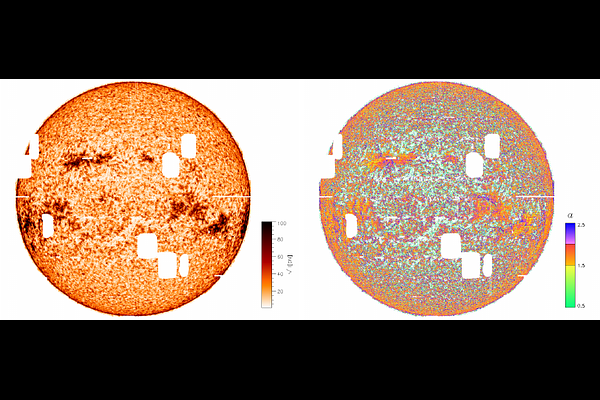
AbstractHigh resolution spectral observations of transition region spectral lines capture the signatures of energy deposition and redistribution at the boundary between the lower and upper atmosphere, and have significant relevance for investigating the physical processes responsible for heating the solar atmosphere. Spectroscopic observations of the solar transition region have long revealed excess line broadening and non-Gaussian profiles, but their physical origin remains debated, and their spatial distribution and prevalence not well established. Here we analyze Si IV line profiles in full-disk mosaics of observations with Interface Region Imaging Spectrograph (IRIS), and show that the non-Gaussian profiles comprise ~60% of the observed profiles, significantly more than previously reported. The IRIS observations, together with magnetic field extrapolations, indicate that the degree of non-Gaussianity systematically depends on the viewing angle between the line of sight and the magnetic field. We find that k-like profiles, indicative of suprathermal velocity distributions, are significantly more prevalent when the magnetic field is oriented at a large angle with respect to the line of sight, at all intensity levels. k-like profiles on average correspond to more limited line width and reduced redshift, compared with Gaussian profiles, particularly in bright regions, such as plage and moss. The results provide observational evidence of the importance of anisotropic kinetic processes in the solar transition region that are not captured by the magnetohydrodynamic approaches that are typically invoked to study the low solar atmosphere. Our observations indicate that more advanced multi-fluid and/or kinetic modeling should be developed.