A Log-Uniform Initial Magnetic Field Distribution Explains Pulsar and Magnetar Populations through Magnetic Inclination Alignment

A Log-Uniform Initial Magnetic Field Distribution Explains Pulsar and Magnetar Populations through Magnetic Inclination Alignment
Takumi Shimasue, Kenta Hotokezaka, Paz Beniamini
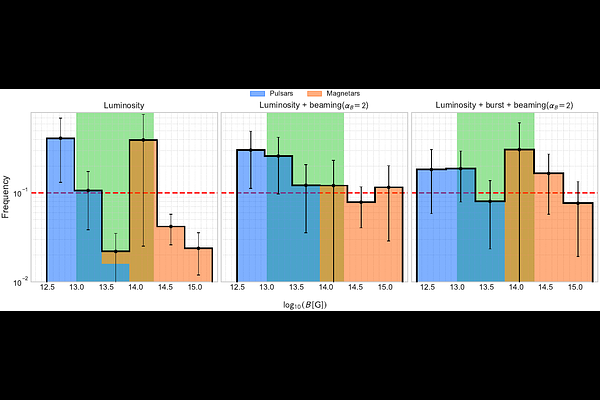
AbstractThe origin of the gap in the observed magnetic field distribution between pulsars and magnetars raises a challenge to understanding these populations within a unified framework. We analytically show that the gap can be naturally explained by the alignment of the magnetic inclination angle between the magnetic and spin axes. Based on coupled evolution of spin-down and magnetic inclination angle in the plasma-filled magnetosphere, the alignment timescale follows $τ_α\propto B^{-2}$. Thus, strongly magnetized neutron stars including high-$B$ pulsars and magnetars align more rapidly than pulsars with $10^{12}\,\mathrm{G}$, reducing their beaming fraction and thereby suppressing their observed numbers. However, magnetars are primarily identified through X-ray activity and are therefore relatively less affected by beaming. Taking into account both beaming fraction and luminosity corrections, we reconstruct the initial magnetic field distribution from the observed distribution. We show that pulsars and magnetars do not dictate intrinsically distinct initial distributions, but can instead be understood within a single continuous initial magnetic field distribution, such as a log-uniform distribution.