Carrollian correlators in black hole perturbation theory

Carrollian correlators in black hole perturbation theory
Jiang Long, Zhan-Jia Qu, Hong-Yang Xiao
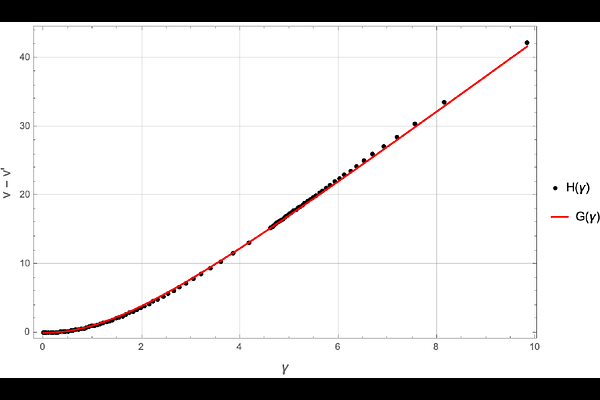
AbstractIn this note, we clarify the relationship between the two-point Carrollian correlator and massless scattering in black hole background. It turns out that there are two kinds of Carrollian correlators at the null boundaries of each asymptotically flat spacetime. The correlator from $\mathscr I^-$ to $\mathscr I^+$ should be regularized by subtracting the flat space analog, and it is the position space version of the reflection amplitude of massless scattering. On the other hand, the correlator from $\mathscr I^-$ to the future horizon $\mathcal H^+$ is absent in flat space, and it is the position space version of the transmission amplitude. The poles of the Carrollian correlators are governed by the null geodesics from $\mathscr I^-$ to $\mathscr I^+$ or $\mathcal H^+$, and they define two kinds of classical equations in Carrollian space. These equations establish the relationship between the Shapiro time delay and the deflection angle for light rays and should be understood as the dual descriptions of the quasinormal modes (QNMs) and the branch cut of the Green's function. We find that the time delay contains a logarithmic/quadratic behavior for the correlator from $\mathscr I^-$ to $\mathscr I^+/\mathcal H^+$ for small deflection angles. On the other hand, the time delay is always increasing linearly for both correlators when the deflection angle is large.