Geodesic flows on a black-hole background

Geodesic flows on a black-hole background
Kaushlendra Kumar, Shahn Majid
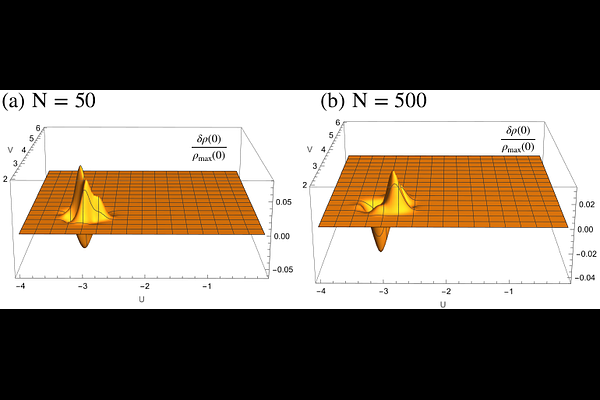
AbstractA recent notion of geodesic flows which comes out of noncommutative geometry but which is also novel in the classical case is studied in detail for a Schwarzschild spacetime. In this framework, the geodesic velocity field is an independent concept which then defines the flow of a density $ρ$ on spacetime or possibly that of an amplitude wave function $ψ$ with $ρ= |ψ|^2$. The proper time flow parameter $s$ is generated collectively by the flow of matter. We show carefully how the $ρ$ evolution can be justified as modelling a large number of geodesics interpolated as a local density. Using Kruskal-Szekeres coordinates, we show that there are no issues crossing the horizon. A novel feature is that whereas two colliding Gaussian bumps in density $ρ$ merge into a single bump, two colliding wave function $ψ$ bumps of opposite phase merge into a dipole with a different density $|ψ|^2$ profile, providing a potential test of our wave-function hypothesis. We also revisit the Klein-Gordon flow or pseudo-quantum mechanics around a black-hole and find that previously found black-hole atom states and modes generated at the horizon when an area of disturbance approaches it are also present inside the black-hole in a reflected fashion. We argue that the behaviour of the horizon modes across the horizon as well as discretisation of the atomic spectrum depend on quantum gravity corrections at the horizon.