PALEOS: Multiphase Equations of State and Mass-Radius Relations for Exoplanet Interiors

PALEOS: Multiphase Equations of State and Mass-Radius Relations for Exoplanet Interiors
Mara Attia, Tim Lichtenberg, Ema Jungová, Mariana Sastre
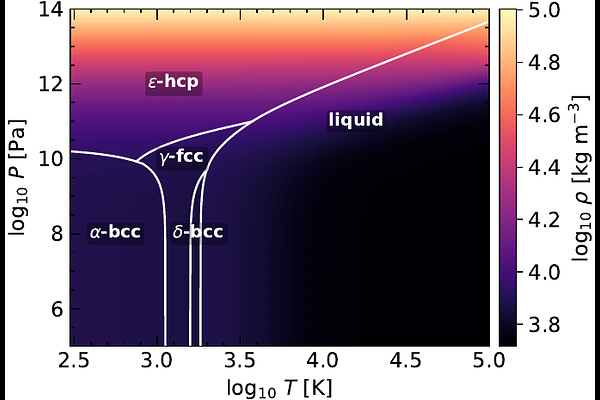
AbstractModeling the interior of a rocky or water-rich exoplanet is a thermodynamic closure problem: every layer's density, temperature gradient, and phase must follow from an equation of state (EoS) that remains self-consistent across the pressure-temperature range from surface to core. Existing EoS span disciplines, use different formalisms, and rarely supply the full thermodynamic quantities needed by evolutionary models of interior phase transitions. We present PALEOS (Planetary Assemblage Layers: Equations of State), an open-source toolkit consolidating EoS for iron, magnesium silicate (MgSiO$_3$), and water (H$_2$O) into a unified, phase-aware, thermally responsive framework spanning 17 phases. PALEOS derives density, energy, entropy, heat capacities, thermal expansion, and the adiabatic gradient analytically via Maxwell relations, and is released as lookup tables on regular P-T grids. We validate it against the Preliminary Reference Earth Model, recovering Earth's radius to 0.3% and lower-mantle densities to 3%, and compute 17,900 mass-radius relations from 0.1 to 100 $M_\oplus$ for rocky (Fe + MgSiO$_3$) and water-rich (Earth-like core + H$_2$O envelope) compositions at 300-4000 K. Continuous solid-to-melt EoS let thermal expansion span the fully-solid to magma-ocean regime: the radius offset exceeds 1% above 1500 K and reaches 16% at 4000 K for low-mass silicate planets, comparable to composition degeneracy and transit-radius uncertainties. We demonstrate this on two ultrashort-period super-Earths, WASP-47 e and TOI-1807 b: each admits two purely rocky solutions indistinguishable in mass and radius but in radically different states, one fully solid with no dynamo, the other hosting a deep magma ocean and a liquid iron core capable of sustaining a magnetic field. Phase-aware, thermally resolved EoS are essential for translating astronomical observations into exoplanetary geophysics.