Geophysical and atmospheric implications of $f$O$_{2}$-dependent melting on rocky exoplanets

Geophysical and atmospheric implications of $f$O$_{2}$-dependent melting on rocky exoplanets
Mariana Sastre, Tim Lichtenberg, Laurent Soucasse, Dan J. Bower, Harrison Nicholls, Inga Kamp
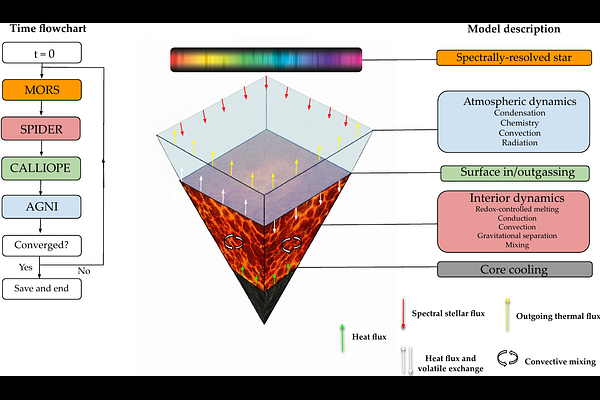
AbstractThe geochemical evolution of long-lived magma oceans is strongly regulated by volatile exchange between the molten mantle and the atmosphere. For planets inside the runaway-greenhouse limit, this coupled evolution can persist for billions of years. However, most existing studies assume Earth-like (oxidized) conditions and neglect the influence of redox state on melt thermodynamics and volatile release. We quantified how experimentally derived, oxygen-fugacity-dependent melting curves implemented within the coupled interior-atmosphere framework PROTEUS propagate into the thermal structure, melt fraction, and rheological evolution of rocky exoplanet interiors, applying this to the short-period super-Earth GJ 1132 b. We found strongly non-linear thermal responses to variations in melting curves. In volatile-poor systems, reduced melting curves promote earlier deep-mantle crystallisation relative to oxidised and Earth-like cases, favouring late-stage surface magma oceans sustained by greenhouse warming, while oxidized melting curves maintain higher melt fractions and a vertically extended magma ocean. Reduced mantles produce massive H$_2$-CO-rich atmospheres; oxidized mantles favour thinner H$_2$O-CO$_2$ envelopes. In volatile-rich systems, the interior reaches radiative equilibrium at high melt fractions, sustaining a steady-state global magma ocean in which melting curve variations do not significantly influence solidification timing. This indicates a hierarchical control: volatile inventory and surface oxygen fugacity act as the primary regulators of thermal state, while oxygen-fugacity-dependent melting relations provide a secondary modulation. These contrasting regimes produce distinct atmospheric compositions and formation timescales, offering testable spectral predictions for close-in rocky exoplanets evaluable with forthcoming JWST observations.