Sub-Neptunes as Soot Factories: Deep Atmosphere Hydrocarbon Formation and Quenching as the Origin of Sub-Neptune Aerosol Trends

Sub-Neptunes as Soot Factories: Deep Atmosphere Hydrocarbon Formation and Quenching as the Origin of Sub-Neptune Aerosol Trends
Jeehyun Yang, Eliza M. -R. Kempton, Arjun B. Savel
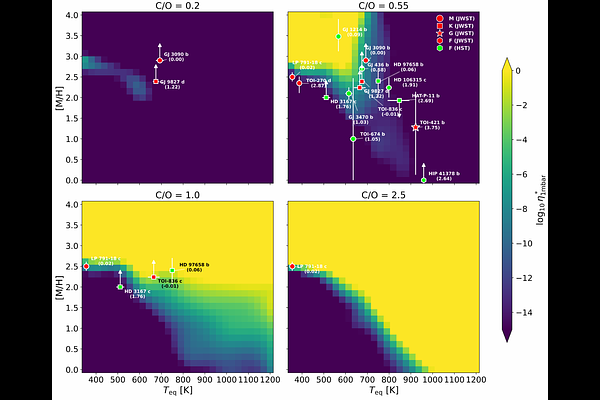
AbstractRecent population-level studies of sub-Neptune atmospheres have identified a parabolic trend in transmission spectrum amplitude for planets with Teq ~ 500-800 K. While the trend has been commonly attributed to hydrocarbon aerosols, we lack a first-principles explanation of its underlying chemical mechanism. Previous work has focused on the role of methane photolysis and subsequent polymerization, but with limited reaction networks that truncated at C2-species and couldn't reproduce the observed parabolic trend. In this work, enabled by a computer-automated, rate-based chemical network generator, we construct the most comprehensive carbon reaction network for exoplanet atmospheres to date. We explicitly model the formation of polycyclic aromatic hydrocarbons (PAHs), which are well established as soot precursors in combustion chemistry. We calculate the chemical timescales of hydrocarbon species through an eigenvalue timescale method and model their quenched abundances across a range of C/O, metallicities, and Teq. In this framework, the deep atmosphere acts as a "soot factory" analogous to a combustion engine, transporting the ingredients for hydrocarbon aerosol formation to the JWST-observable region of the atmosphere, where it may be further augmented by photochemistry. We find that the predicted abundances of PAHs peak near 600 K, and fall off toward higher and lower Teq, in agreement with the observed parabolic trend and existing JWST and HST observations. We also show that PAH abundances are expected to vary with C/O and metallicity, thus providing a natural explanation for observed diversity among planets with similar Teq.