Signatures of localised particle acceleration at a global coronal shock wave

Signatures of localised particle acceleration at a global coronal shock wave
C. Cuddy, D. M. Long, M. Nedal, S. Bhunia, P. T. Gallagher
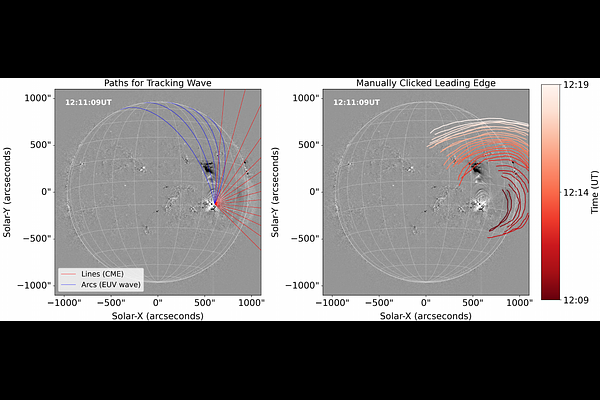
AbstractExtreme ultraviolet (EUV) waves are global waves in the solar corona which can accelerate particles. The efficiency of the acceleration depends on local plasma characteristics e.g. Alfvén speed and the geometry of the magnetic field. This shock-driven particle acceleration can produce radio signatures such as Type II radio bursts and herringbone emission. Here we investigate signatures of particle acceleration by a weak coronal shock on 10 March 2024. In particular, we combine EUV images with radio imaging and spectral observations to determine how and where this weak shock could accelerate energetic particles. A potential field source surface extrapolation was used to examine the pre-eruption ambient magnetic field while the evolution of the global wave was probed using running difference and base difference EUV images. The EUV images enabled the speed and Alfvén Mach number of the EUV wave to be characterised. The combination of radio images and dynamic spectra provide evidence of beams of shock-accelerated electrons localised to a dimming region at the time the EUV wave passes through it. The speeds and energies of these electrons were estimated from the drift rates of their herringbones. The EUV wave initially propagated West, channelled by loop systems, before changing direction northward. From the EUV intensity jump at the wavefront, the Alfvén Mach number was estimated to be approximately 1.005 at the time that the herringbones were produced. The herringbone drift rates revealed accelerated electron energies of 75-122 keV, using Newkirk density models with scaling factors of 1.3-2.6. These observations suggest that the weak lateral shock impacted quasi-perpendicular open field in a dimming region, enabling localised particle acceleration. This indicates that the geometry of the ambient magnetic field relative to the shock strongly governs where particles can be accelerated.