Low-ionization Metal Absorption at $0.7 \lesssim z \lesssim 2$ Confronting Cosmological Simulations with Observations

Low-ionization Metal Absorption at $0.7 \lesssim z \lesssim 2$ Confronting Cosmological Simulations with Observations
Ivan Rapoport, Ehud Behar, Vincent Desjacques
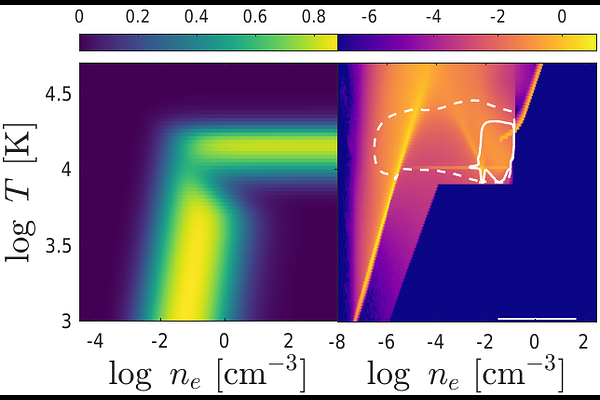
AbstractLow-ionization metal absorption lines provide a primary probe of cool gas in and around galaxies. We confront observations of metal-line absorption in quasar spectra with predictions from the IllustrisTNG cosmological simulation in order to benchmark how well current galaxy formation models reproduce the observed circumgalactic medium (CGM) and intergalactic medium (IGM) absorption signatures. We implement two ionization prescriptions: a purely collisional model and a model including photo-ionization by a uniform ultraviolet background (UVB). Using a grid-based framework, we compute MgI, MgII and FeII column densities and construct column density probability distribution functions (PDFs) and equivalent width (EW) statistics for comparison with observations. The observational samples considered here are based on the High Resolution Echelle Spectrometer (HIRES), the Ultraviolet and Visual Echelle Spectrograph (UVES), the Sloan Digital Sky Survey (SDSS) and the Dark Energy Spectroscopic Instrument (DESI). The computed PDFs broadly reproduce the observed ones across the sampled column density range of $10^{11.4}\lesssim \text{N}\lesssim 10^{16}\ \rm{cm^{-2}}$, indicating that the simulation captures the dominant physical drivers of low-ionization absorption. We then compute the cosmic incidence of MgII systems, namely the evolution of their number with redshift $d\mathcal{N}/{dz}$. The model that includes UVB accurately produces $d\mathcal{N}/{dz}$ up to equivalent widths (EW) of $\rm W_0^{2796} < 0.6\ \mathring{A}$, consistent with low-density photo-ionized gas in the outer CGM. At high EWs of $\rm W_0^{2796} > 1\ \mathring{A}$ TNG underestimates $d\mathcal{N}/{dz}$ and fails to capture its rise toward $z\sim2$.