Data-Constrained Modeling of Electron Transport and Asymmetric Precipitation in the 2011 August 4 Solar Flare

Data-Constrained Modeling of Electron Transport and Asymmetric Precipitation in the 2011 August 4 Solar Flare
Feiyu Yu, Xiangliang Kong, Ze Zhong, Zhentong Li, Zelong Jiang, Yingli Cui, Zhao Wu, Yao Chen, Gang Li
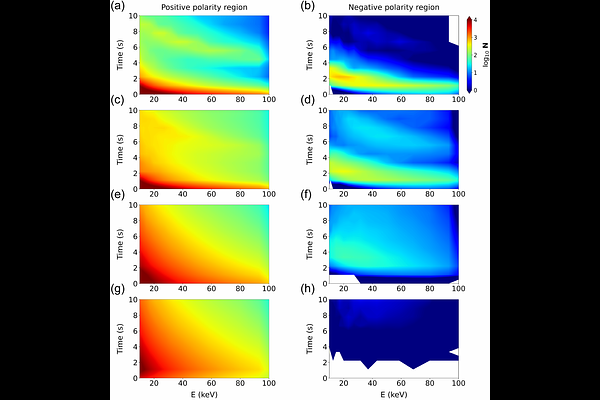
AbstractEnergetic electrons accelerated at coronal reconnection sites during solar flares precipitate into the lower solar atmosphere, generating nonthermal emissions and regulating energy deposition. However, how their transport and precipitation are jointly governed by the three-dimensional (3D) magnetic topology, turbulent scattering, and Coulomb collisions remains unclear. Here, we aim to disentangle these physical processes by using a data-constrained 3D particle transport model for the 2011 August 4 flare. The simulated distribution of precipitated electrons aligns closely with photospheric quasi-separatrix layers and reproduces the observed two-ribbon morphology in 1700~Å. We reveal a strong polarity asymmetry, with the 10~s precipitation fraction about six times higher in the weak positive polarity. This arises primarily from distinct mirror ratios of different polarities under the 3D magnetic configuration and can be understood via a modified escape probability for an asymmetric magnetic bottle. Varying strengths of turbulent scattering lead to a rise-then-fall trend and a pronounced energy dependence in the precipitation fraction. Coulomb collisions globally suppress precipitation, especially at low energies, and further amplify the polarity asymmetry. This integrated modeling framework bridges detailed transport physics to observable flare emissions and advances the development of quantitative models for realistic solar flare events.