A Close Quasar Pair in a Massive Galaxy Merger at $z=5.7$

A Close Quasar Pair in a Massive Galaxy Merger at $z=5.7$
Minghao Yue, Xiaohui Fan, Anna-Christina Eilers, Feige Wang, Jinyi Yang, Robert A. Simcoe
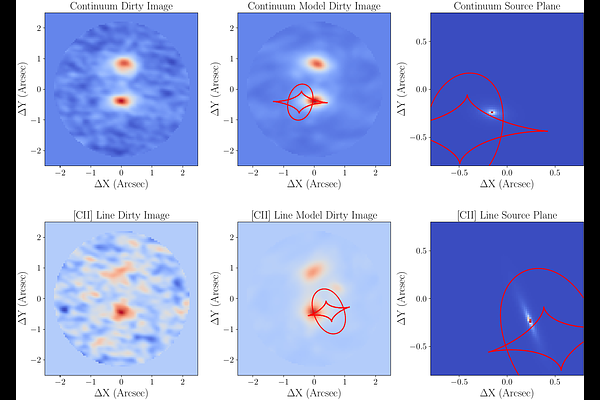
AbstractClose quasar pairs are rare products of galaxy mergers in which both supermassive black holes (SMBHs) are actively accreting, offering strong constraints on merger-driven active galactic nuclei (AGN) evolution. Identifying close quasar pairs at $z\gtrsim4$ is challenging due to the declining quasar number density in the early Universe. Here we report the confirmation of a close quasar pair at $z=5.7$, J2037--4537, utilizing high-resolution Atacama Large Millimeter/submillimeter Array (ALMA) observations. The quasar host galaxies exhibit tidal disturbed features in both the far-infrared continuum emission and the {\cii} line emission, ruling out the doubly-imaged lensed quasar scenario. The two quasar hosts are massive $(M_\text{dyn}\gtrsim10^{10}M_\odot)$ and star-forming (SFR $\gtrsim500 M_\odot~ \mathrm{yr^{-1}}$). The confirmation of J2037--4537 puts a lower limit on the quasar pair fraction at $5.5<z<6$, $F_\text{pair}>1.2\%$, which is much higher than the quasar pair fraction at $z\lesssim4$. J2037--4537 is expected to form a gravitationally-bound SMBH binary within $\lesssim2$ Gyr. The elevated quasar pair fraction at $z>5.5$, as indicated by J2037--4537, likely contributes to the high gravitational-wave background reported by recent Pulsar Timing Array experiments.