Orbital motion detected in gamma Cas Fe K emission lines

Orbital motion detected in gamma Cas Fe K emission lines
Yael Naze, Masahiro Tsujimoto, Gregor Rauw, Sean J. Gunderson
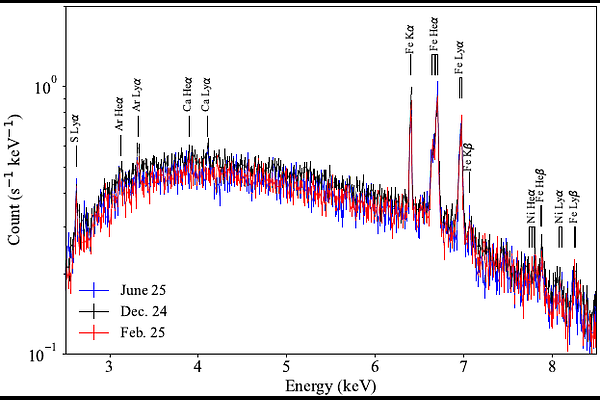
AbstractA subset of Be stars, typified by the naked-eye star gamma Cas, exhibits unusually bright and hard X-ray emission, the origin of which has remained debated for five decades. We performed high-resolution X-ray spectroscopic monitoring of gamma Cas with the Resolve instrument aboard the X-Ray Imaging and Spectroscopy Mission (XRISM). X-ray lines from the ultra-hot plasma and fluorescence from cooler material exhibit Doppler shifts consistent with orbital motion, not of the Be star itself, but of its low-mass companion (previously shown to be a white dwarf). This first evidence of orbital motion for the hard X-ray emitting plasma uniquely links it to the scenario of accretion onto the white dwarf companion. The modest line broadening further indicates that fluorescence occurs on the white dwarf surface and excludes X-ray generation in the inner parts of an accretion disc. Our findings identify gamma Cas and its analogues as the previously elusive, but long predicted class of binaries composed of a Be and a white dwarf. Identifying the origin of the hard X-rays from gamma Cas and its analogues, which represent about 10% of early-type Be stars, provides a key input for population synthesis models of massive binary evolution.