The impact of evolving cosmic filaments on mass and spin evolution of dark matter halos

The impact of evolving cosmic filaments on mass and spin evolution of dark matter halos
Hannah Jhee, Hyunmi Song, Clotilde Laigle, Christophe Pichon, Corentin Cadiou, Ena Choi
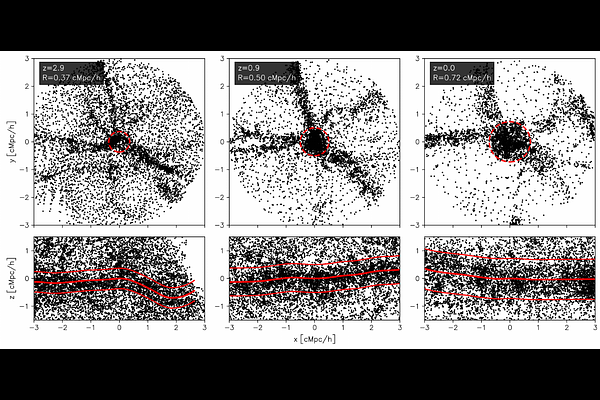
AbstractThe evolution of galaxies is closely tied to that of their host dark matter halos, which is in turn strongly modulated by the surrounding large-scale environment. Cosmic filaments are expected to influence the peculiar motions, mass assembly and angular momentum of nearby halos through highly anisotropic matter flows. In order to fully capture the dynamic interplay between the filaments and halos, we develop an algorithm to trace the progenitors of individual filaments identified at z=0 with DisPerSE in a cosmological N-body simulation, by quantifying the spatial similarity between a descendant filament and progenitor candidates. This enables us to reconstruct filament-by-filament evolutionary histories, including their bulk drift and the evolution of density profiles, from which splashback radii and core overdensities are derived. Using these time-dependent properties, we re-examine halo phase-space trajectories in a filament-centric frame that evolves with time. This eliminates biases inherent to static models by separating halo motions from the motion of the filaments, allowing trajectories to be identified more reliably. We find that as halos approach high-density filaments, their mass accretion rates are systematically suppressed beginning at the filament outskirts, suggestive of tidal stripping or suppressed net accretion. Furthermore, the evolution of halo spin alignments exhibits a clear departure from stochastic random-walk expectations. This suggests that distinct mass flow regimes in and around filaments exert different torques on infalling halos, thereby changing their angular momentum. Our findings, derived from a sample screened for major mergers, highlight the pure dynamical impact of the filamentary environment. Ultimately, we demonstrate that tracking the simultaneous co-evolution of filaments and halos is essential for accurately characterizing environmental effects.