JWST observations of photodissociation regions. IV. Carbonaceous emission band sub-components in NGC 7023 have distinct spatial distributions

JWST observations of photodissociation regions. IV. Carbonaceous emission band sub-components in NGC 7023 have distinct spatial distributions
D. Van De Putte, K. D. Gordon, K. Misselt, A. N. Witt, A. Abergel, A. Noriega-Crespo, P. Guillard, M. Zannese, M. Elyajouri, B. Trahin, P. Dell'ova, M. Baes, P. Klaassen
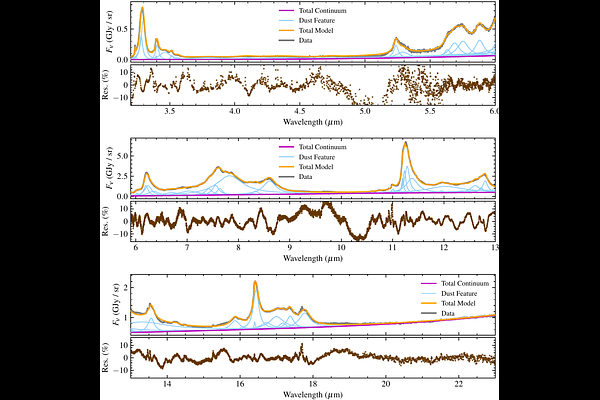
AbstractWe analyze JWST spectroscopy of the northwest filament of NGC7023, where the relatively soft radiation field results in a photodissociation region with an extended atomic hydrogen region, and strongly pronounced variations of the carbonaceous emission band profiles. We focus on the 16.4 and 17.4 um bands and their relation to the main bands at 3.3, 3.4, 5.2, 5.7, 6.2, 7.7, 8.6, 11.3, and 12.7 um, and aim to identify which bands and sub-features originate from co-spatial emission carriers. We apply a PAHFIT spectral decomposition to measure the emission bands and their individual sub-components, and produce maps that spatially resolve the main dissociation front (DF1). Nearly all emission maps peak at DF1, while the relative intensity in the atomic hydrogen region (ATM) varies strongly. We classify the features into spatial distribution types based on the intensity ratio in ATM relative to DF1. Most bands are of type I (low ATM/DF1; 3.3, 3.4, 5.2, 5.7, 11.3 um) or II (medium ATM/DF1; 16.2, 7.7, 8.6, 12.7, 16.4 um), while only few are of type III (high ATM/DF1; 11.0, 17.4 um). A breakdown of the 5.7, 7.7, 11.3 and 12.7 um bands into blue and red sub-components reveals that contributions on the blue side are of type III, while those on the red side are of type I or II. These strongly differing spatial distributions reveal that at least two different populations contribute to the 16-18 um range, and that these populations are also connected to the profiles of the 5.7, 7.7, 11.3, and 12.7 um bands. The maps further indicate a continued evolution of these profiles toward the central cavity of NGC7023, where fullerene emission (C60) was previously detected. We speculate that the population of emission carriers could be in an intermediate photochemical evolution stage that precedes fullerene formation.