Giant impact between high-viscosity Theia and low-viscosity proto-Earth: Origin of lunar isotopic crisis

Giant impact between high-viscosity Theia and low-viscosity proto-Earth: Origin of lunar isotopic crisis
Wenshuai Liu
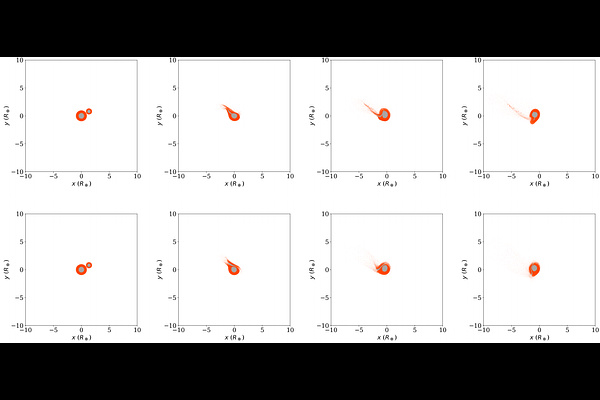
AbstractAccording to the giant impact theory, the Moon was formed by accretion of the debris disk that resulted from the collision between Theia and the proto-Earth. Although this theory accounts for most characteristics of the Earth-Moon system, numerical simulations of impacts between a planetary embryo and the accreting proto-Earth indicate that more than 40 percent of the material in the circum-terrestrial disk generated by such an impact originates from the impactor. This poses a challenge for the giant impact theory in explaining the Moon's Earth-like isotopic composition, a discrepancy known as the lunar isotopic crisis. Since terrestrial planets were melted one or more times during accretionary processes, magma ocean on the surface of a growing planet would appear. Small terrestrial planets with magma ocean cool faster than large ones, resulting that the viscosity of small terrestrial planets is larger than that of large terrestrial planets still covered by magma ocean. Here, it shows that giant impact between a high-viscosity Theia and a low-viscosity proto-Earth could produce a circum-terrestrial debris disk predominantly composed of material from the proto-Earth without violating the angular momentum constraint of modern Earth-Moon system. The theory proposed here may provide a natural way of explaining the lunar isotopic crisis.