Dynamical response of a protoplanetary disk to an FU Ori-type outburst

Dynamical response of a protoplanetary disk to an FU Ori-type outburst
Roman Zolotarev, Yaroslav Pavlyuchenkov, Vitaly Akimkin
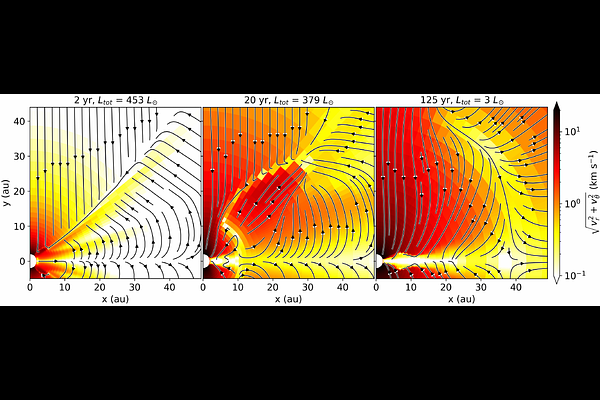
AbstractEpisodic accretion events onto young stars can significantly change the global structure of their surrounding protoplanetary disks. Using radiation hydrodynamical simulations with the HURAKAN code, we study the response of the outer passive disk to a powerful FU Ori-type outburst. Disk heating initiates a factor-of-two increase in the vertical scale-height, which develops on a local keplerian timescale. This effectively launches an outward travelling wave with a bump whose radial position changes with time as $r_{b}\sim t^{2/3}$. After the outburst ends, new waves are launched as the disk structure re-equilibrates toward a quiescent state. The vertical expansion of the disk introduces significant time-variable extinction of the central source emission. Disks with inclinations in the range $40^{\circ}<i<60^{\circ}$ go from weakly ($A_{V}<1$) to a strongly embedded state ($A_{V}\sim10^2$), with the extinction decaying on a $\sim10^2$ yr timescale after the outburst. A fingerprint of the outburst-launched shadowing wave is a long-lived drop or a transient dip in the luminosity curve occurring several years after the outburst begins. This apparent luminosity variation is relatively large, up to $1^m-3^m$ in the V band, and is not related to the intrinsic accretion variability.