Understanding the formation of alpha-Fe bimodality in the Milky Way using constrained cosmological simulations of the Local Group

Understanding the formation of alpha-Fe bimodality in the Milky Way using constrained cosmological simulations of the Local Group
Anna Genina, Ewoud Wempe, Amina Helmi, Hanneke C. Woudenberg, Simon D. M. White, Robert J. J. Grand, Ruediger Pakmor, Guilhem Lavaux, Jens Jasche
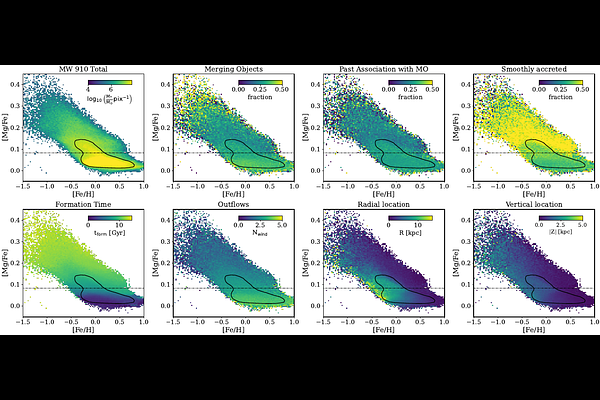
AbstractWe use a novel suite of constrained cosmological simulations of the Local Group to investigate the formation of alpha--Fe bimodalities in stellar discs of Milky Way analogues. In agreement with past studies using the Auriga model, we show that in our simulations the high-alpha sequence forms in a merger-induced starburst, which further quenches star formation, allowing the new stellar populations to form at low [alpha/Fe]. Producing a bimodality that is prominent at large radii, with a significant [alpha/Fe] gap and overlapping metallicity as in the Milky Way, requires the quenching of star formation across all radii where the bimodality is observed. The quenching can be achieved either with a galaxy-wide starburst, or with a retrograde merger reducing angular momentum in the outer disc and allowing more efficient dilution by the metal-poor gas in the circumgalactic medium (CGM). We show that mergers can also tilt the disc, changing the direction of galactic outflows and enriching a larger volume of the CGM with galactic metals, leading to low [alpha/Fe] scatter in the subsequently formed low-alpha sequence. We argue that the slopes in [alpha/Fe] of the two alpha sequences are crucial in narrowing down the mechanism that leads to their formation. We additionally uncover an indirect role that mergers play in enhancing the accretion of metal-poor gas onto galaxies. The smoothly accreted gas can dominate the gas content in the CGM and aid in the formation of distinct chemical sequences, especially at the low-metallicity end.