Variability classification of TESS targets in LOPS2, the first long-term pointing field of PLATO. Version 1 of the public variability catalogue

Variability classification of TESS targets in LOPS2, the first long-term pointing field of PLATO. Version 1 of the public variability catalogue
Mykyta Kliapets, Pablo Huijse, Jeroen Audenaert, Andrew Tkachenko, Marek Skarka, Paul F. X. Gregory, Dominic M. Bowman, Simon J. Murphy, Poojan Agrawal, József M. Benkő, Hannah Brinkman, Nicholas Jannsen, Yoshi Nike Emilia Eschen, Allison Eto, Dario J. Fritzewski, Alex Kemp, Viktor Khalack, Gang Li, Ricardo Ochoa-Armenta, Inês Rolo, Nena Scheller, Rose S. Stanley, Keegan Thomson-Paressant, Emese Plachy, Vincent Vanlaer, Mathijs Vanrespaille, Jasmine Vrancken, Haotian Wang, Yian Xia, George R. Ricker, Conny Aerts
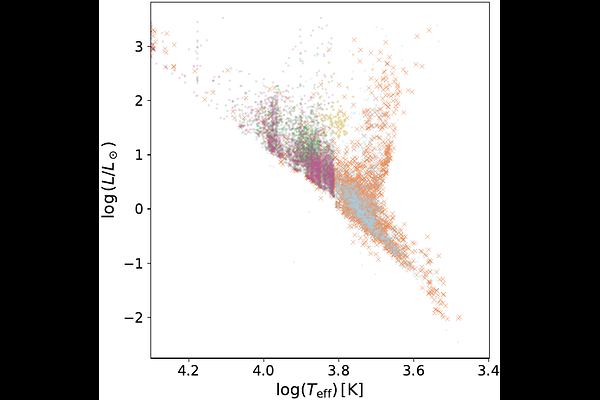
AbstractThe PLAnetary Transits and Oscillations of stars (PLATO) mission is expected to launch in January 2027. A total of 8\% of its data rate will be dedicated to complementary science targets selected from approved Guest Observer proposals. We seek to provide an open-source catalogue of variable stars in PLATO's first long-term observing field, LOPS2. We want to use existing observations from the Transiting Exoplanet Survey Satellite (TESS), which has observed many stars in LOPS2. We classified 38 million calibrated aperture light curves from the TESS-Gaia Light Curve pipeline (TGLC, $G\lesssim17$) for 6 million unique sources in LOPS2 with two machine learning frameworks -- a deep neural network and a feature-based gradient-boosted decision-tree ensemble. We combined their predictions to create this first version of the LOPS2 variability catalogue, performed manual vetting of a sub-sample classified light curves, and a statistical analysis of the results to validate our methodology and to assess the variability properties and parameters of the stars in the catalogue. Our classification resulted in the identification of approximately 72% of the light curves having dominant instrument- or pipeline-induced signal, with the remaining 28% representing 3.6 million individual candidate variable stars, including pulsating, rotating, and eclipsing stars. Candidate pulsators exhibit varied behaviour in terms of their frequencies, amplitudes, rotation, and fundamental parameters. To ensure purity of the samples, filtering on colour, luminosity, the dominant frequency and its amplitude, and presence of close neighbours is helpful. We provide the first version of our PLATO LOPS2 variability catalogue to the community for further study and scrutiny. It is to date one of the largest catalogues of variable stars from an automated classification pipeline.