MEOW: The increase in the obscured AGN fraction in mid-infrared from 0 < z < 6 with JWST MIRI

MEOW: The increase in the obscured AGN fraction in mid-infrared from 0 < z < 6 with JWST MIRI
Teodora-Elena Bulichi, Gene C. K. Leung, Anna-Christina Eilers, Pablo G. Perez-Gonzalez, Guillermo Barro, Steven L. Finkelstein, Micaela B. Bagley, Anton M. Koekemoer, Bren E. Backhaus, Mark Dickinson, Norman A. Grogin, Dale D. Kocevski, Ray A. Lucas, Fabio Pacucci, Nor Pirzkal, Elia Pizzati, Jan-Torge Schindler, Alberto Traina, Guang Yang
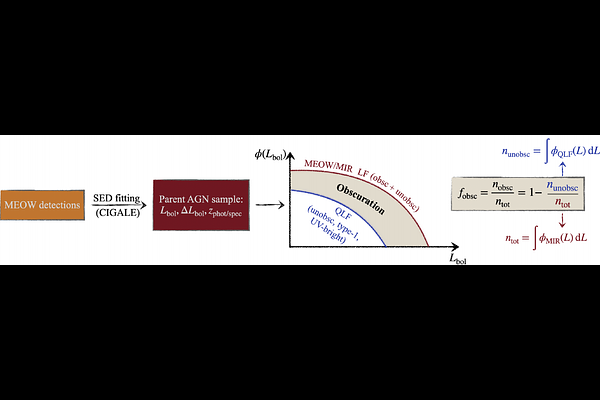
AbstractObscured active galactic nuclei (AGN) are often invoked to explain the rapid emergence of young quasars at high redshift and are crucial for building a complete census of AGN activity and black hole growth. The advent of the James Webb Space Telescope (JWST) extends the discovery space for obscured AGN into the mid-infrared (mid-IR) with unprecedented precision through reprocessed dust emission. In this work, we use deep JWST Mid-Infrared Instrument (MIRI) imaging from the MIRI Early Obscured AGN Wide Survey (MEOW), together with existing JWST Near Infrared Camera (NIRCam), spectroscopic, and Hubble Space Telescope imaging data, to identify a previously unrecognized population of obscured AGN out to z ~ 6. Using spectral energy distribution (SED) modeling of the MIRI-detected sources, we identify 883 AGN over an area of ~ 131 arcmin2 and construct the AGN bolometric luminosity function, including both obscured and unobscured sources, across five redshift bins. We find an excess in AGN abundance relative to UV-selected AGN luminosity functions, indicating a substantial obscured population missed by optical/UV surveys, with the inferred obscured fraction increasing with redshift and reaching ~ 98-99% in our highest-redshift bin, 4.5 < z < 6. We also find higher AGN abundances and obscured fractions than X-ray-based studies, consistent with a previously unrecognized population of heavily obscured, Compton-thick AGN revealed by mid-IR selection. These results suggest that a large fraction of supermassive black hole growth at early times occurs during heavily obscured phases largely inaccessible at other wavelengths.