An Atmosphere on the Ultra-Short Period super-Earth HD 3167 b

An Atmosphere on the Ultra-Short Period super-Earth HD 3167 b
Brandon Park Coy, Qiao Xue, Megan Weiner Mansfield, Jason D. Eastman, Anjali A. A. Piette, Tyler Fairnington, Cole Smith, Michael Zhang, Eliza M. R. Kempton, Jacob L. Bean, Xuan Ji, Peter Gao, Jegug Ih, Daniel D. B. Koll, Rafael Luque, Jaume Orell-Miquel, Edwin S. Kite
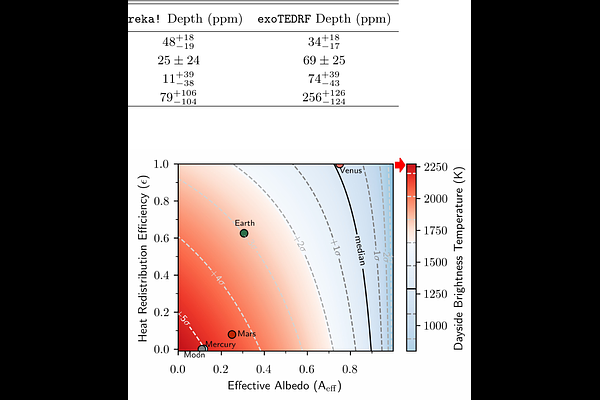
Abstract'Lava worlds'-Earth-sized planets hot enough (Teq >~ 1100 K) to melt their dayside silicate surfaces-have emerged as promising candidates for atmospheric detection and characterization. Thermal emission observations show an apparent dichotomy: the hottest lava worlds have colder daysides than the temperature of a maximally emitting bare rock, indicating the likely presence of thick and/or reflective atmospheres while the coldest ones do not. However, where in instellation flux this potential bifurcation occurs is uncertain. We present a JWST MIRI LRS eclipse of the ultra-short period (USP) lava world HD 3167 b (Teq = 1786 K, R = 1.6 Rearth, P = 0.96 d) that helps bridge this gap. We measure the white light eclipse depth to be 38 +/- 11 ppm, more than 5 sigma lower than the expected eclipse depth of a dark, maximally hot bare rock. We use this to derive a dayside brightness temperature that is best explained by the presence of an atmosphere that cools the dayside by reflecting incoming starlight and/or efficiently redistributing heat to the planet's nightside. An atmosphere is further compatible with the planet's slight under-density compared to an Earth-like composition. The corresponding dayside emission spectrum is not precise enough to constrain atmospheric composition, motivating follow-up spectroscopic observations with JWST NIRSpec. Lastly, we use our observation and existing data to refine key planetary parameters of the HD 3167 system. HD 3167 b is currently the least irradiated USP super-Earth with evidence for an atmosphere.