Stars on the ascending helium giant branch I. From white dwarf merger to helium giant: the evolutionary state of the rapidly rotating hot subdwarf HE 1518-0948

Stars on the ascending helium giant branch I. From white dwarf merger to helium giant: the evolutionary state of the rapidly rotating hot subdwarf HE 1518-0948
M. Pritzkuleit, M. Dorsch, M. M. Miller Bertolami, S. Geier, C. W. Bradshaw, H. Dawson
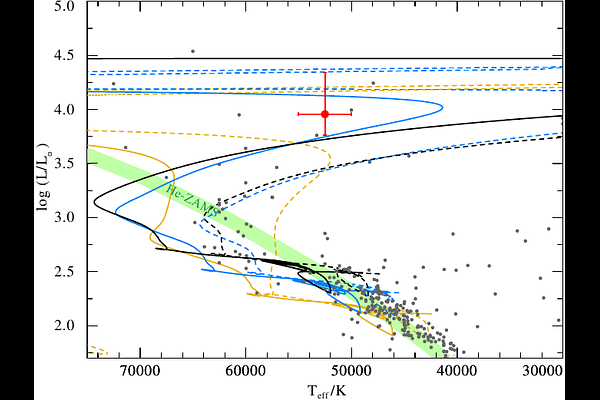
AbstractHot subdwarf stars with masses above $0.8 M_\odot$ ascend the helium giant branch after the end of core helium burning, before entering the white dwarf cooling track or exploding as type Ib/c supernovae. Such massive helium stars are typically expected to form through the stripping of an intermediate mass star by a binary companion after which some hydrogen is still expected to be retained. However, the subclass of extreme helium rich hot subdwarfs (He-sdOs) shows no or very weak hydrogen traces, and their low binary fraction suggests that they are either created through single-star evolution triggered by a late hot flash in a low-mass red giant or the merger of two helium white dwarfs. Most He-sdOs are located close to the helium zero-age main sequence, while a small number exhibit much lower surface gravities, indicating inflated radii. Whether these objects are evolutionarily connected to the main He-sdO population remains unclear. In this work, we analyse the luminous, extreme helium-rich, low-surface-gravity sdO HE 1518-0948 (HE 1518) through a detailed spectroscopic study of optical and ultraviolet data. A comparison with evolutionary models indicates that HE 1518 is the product of a massive double helium white dwarf merger and is currently undergoing helium shell burning while ascending the helium giant branch. This makes HE 1518 one of only a few known objects located in this sparsely populated region of the Hertzsprung-Russell diagram. Such stars provide valuable laboratories for studying the evolution of massive hot subdwarfs beyond core helium burning, and their high luminosities allow them to be detected at large distances.