Localizing binary neutron stars with the Einstein Telescope: a full Bayesian comparison of the triangular and 2L configurations

Localizing binary neutron stars with the Einstein Telescope: a full Bayesian comparison of the triangular and 2L configurations
Filippo Santoliquido, Jacopo Tissino, Marica Branchesi, Ulyana Dupletsa
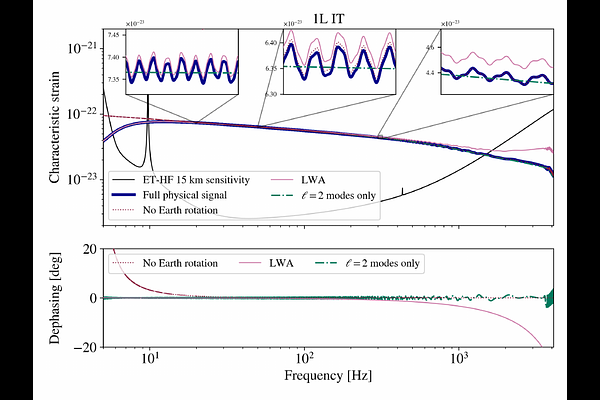
AbstractThe Einstein Telescope (ET), the European next-generation gravitational-wave observatory, is at a decisive stage: the choice of its detector configuration is still open, with profound implications for its scientific output. We provide a quantitative basis for this choice by comparing two candidate configurations at their proposed sites: the triangular design ($Δ$) at the Euregio Meuse-Rhine site, and the 2L design, with interferometers in Sardinia, Italy, and Lusatia, Germany. We present the first realistic estimates of sky-localization uncertainties for binary neutron star (BNS) mergers, moving beyond Fisher-matrix forecasts to full Bayesian parameter estimation that captures the multimodal structure of the sky posterior. We focus mainly on the high-frequency interferometers alone, providing an expected scenario for the first years of ET operations, as the more challenging low-frequency instruments will come online later. BNS injections span different sky positions and luminosity distances between 40 and 2000 Mpc, corresponding to signal-to-noise ratios (SNRs) from 12 to 720. Our analysis relaxes the long-wavelength approximation and includes Earth's rotation and higher-order modes, all of which improve sky localization. We find that the $Δ$ configuration localizes low- and moderate-SNR sources in eight degenerate sky modes spread across both hemispheres and over the day and night sides of the Earth, with 90% credible areas reaching $\sim 2 \times 10^4 \, \mathrm{deg}^2$. In contrast, the 2L configuration recovers a single dominant mode that contains at least 50% of the posterior probability and is one to two orders of magnitude smaller in area. This represents a substantial advantage for multimessenger follow-up campaigns.