Systematic census of RR Lyrae stars in Milky Way stellar streams

Systematic census of RR Lyrae stars in Milky Way stellar streams
Bruno Domínguez, Cecilia Mateu, Pau Ramos, Guillaume F. Thomas
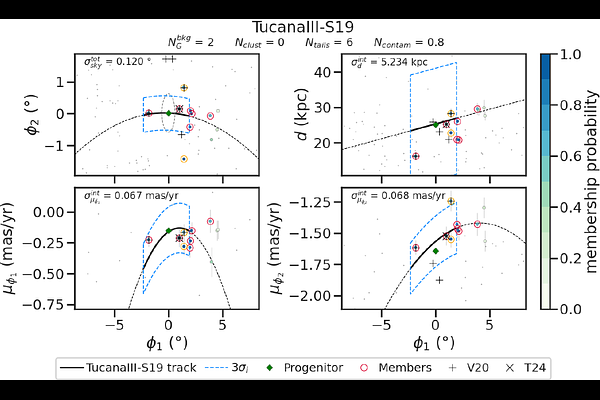
AbstractContext. Nearly 150 tidal streams are known in the Milky Way, but full phase-space information exists for only a few. RR Lyrae stars (RRL), as standard candles, provide a powerful way to probe these structures, yet they have been identified in less than a dozen streams. Aims. We study the RRL population in all known stellar streams with reported proper motions in the galstreams library, performing the first systematic census of these stars. Our goals are to identify likely RRL members, map distances along streams, and compare RRL populations in streams and their progenitors. Method. We use a union of the largest RRL catalogs (Gaia DR3 SOS, PS1, and ASAS-SN-II) to construct a Bayesian probabilistic membership model and find 361 RRL in the 56 streams studied. Results. i) We find that 32 of the 56 streams have RRL in their tidal tails -- 13 with progenitors and 19 without; 13 of these contain more than 3 RRL in their tails. ii) We report new RRL detections in 31 of these streams, anchoring distances and, in particular, inferring new distance gradients for 5 of them. iii) Our method provides intrinsic dispersion estimates in distance and proper motion for each track and statistically quantifies the expected contamination. iv) The census revealed some complex origin histories, such as the new plausible origin scenario we propose for M92 with multiple progenitors. v) We find that the presence of RRL in the tidal tails is linked to the late stages of progenitor dissolution. Conclusions. This census represents a first step toward identifying which of the studied stellar streams contain a significant number of RRL based on currently reported tracks while also providing a homogeneous and robust catalog of RRL members with precise empirical distances, crucial for a full phase-space analysis of these structures and their use as probes of the Galaxy's history and gravitational potential.