Streaming instabilities in weakly ionized protoplanetary discs: the Ambipolar Streaming Instability (AmSI)

Streaming instabilities in weakly ionized protoplanetary discs: the Ambipolar Streaming Instability (AmSI)
Arnaud Pierens, Min-Kai Lin
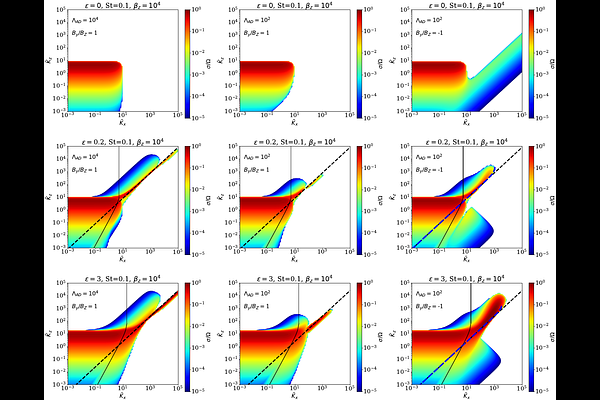
AbstractThe regions of protoplanetary discs where planets can form are believed to be weakly ionised, suggesting thereby that non-ideal magneto-hydrodynamics (MHD) effects play an important role in the disc dynamics and in the planet formation process. In particular, the combined effect of ohmic resistivity and ambipolar diffusion can be responsible for launching MHD-driven disc winds. In this context, we focus on the effect of ambipolar diffusion (AD) and examine the stability of a dusty, magnetized disc by employing both linear stability analyses and numerical simulations. We show that dust feedback tends to stabilize the MRI oblique modes involved in the ambipolar-shear instability. We also find that ambipolar diffusion leads to the onset of a strong resonant drag instability (RDI), in which an Alfvén wave is destabilized by the relative drift between the gas and dust components. The main impact of AD is to modify the Alfvén wave frequency, resulting in a large resonance width. The instability is found to have significant growth rates even in dust-poor discs and for tightly coupled particles, which may help to bridge the gap between growth of dust grains through coagulation and planetesimal formation.