Peering down the barrel with DESI DR2: 10 000+ inflows at $z$ < 0.6 reveal how galaxies accrete cold gas

Peering down the barrel with DESI DR2: 10 000+ inflows at $z$ < 0.6 reveal how galaxies accrete cold gas
S. Weng, A. Saintonge, Matthew M. Pieri, J. Moustakas, H. Zou, D. Muñoz Santos, J. Yu, J. Aguilar, S. Ahlen, D. Bianchi, D. Brooks, T. Claybaugh, A. Cuceu, A. de la Macorra, P. Doel, A. Font-Ribera, J. E. Forero-Romero, E. Gaztañaga, Satya Gontcho A. Gontcho, G. Gutierrez, C. Hahn, S. He, K. Honscheid, T. Hu, R. Joyce, R. Kehoe, M. Landriau, L. Le Guillou, A. Meisner, R. Miquel, S. Nadathur, J. A. Newman, W. J. Percival, I. Pérez-Ràfols, G. Rossi, E. Sanchez, D. Schlegel, H. Seo, J. Silber, D. Sprayberry, G. Tarlé, B. A. Weaver
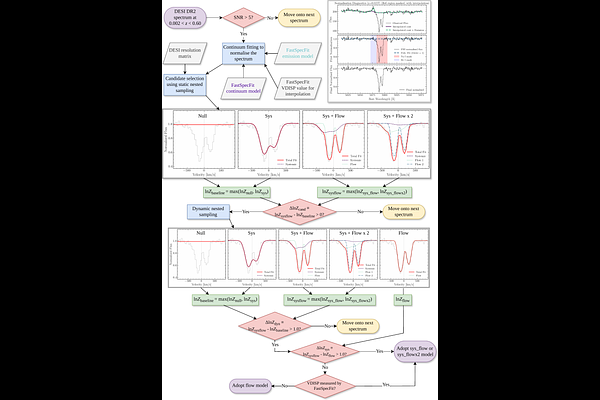
AbstractDirect observational constraints on how galaxies acquire their gas remain remarkably limited, hindering our understanding of the baryon cycle. We present a search for down-the-barrel \ion{Na}{i} D absorption towards 15.6 million galaxies at $z < 0.6$ in DESI Data Release 2. We use Bayesian evidence ratios to assess whether the absorption requires additional components tracing interstellar gas distinct from the systemic component of the galaxy. We construct a catalogue of 50 088 (27 420) galaxies with moderate (strong) evidence for down-the-barrel absorption. The inferred absorption components are broadly distributed in velocity, with approximately 50% at $v_{\rm flow} < -50$ km/s, 30% within 50 km/s of the systemic velocity and the remaining 20% at $v_{\rm flow} > 50$ km/s. We find strong evidence for a large population of low-velocity, infalling absorbers with velocities $\sim$20 km/s in edge-on galaxies, consistent with radial inflows predicted in simulations. The stronger correlation in early-type galaxies between inflow velocity and stellar velocity dispersion, compared to that with stellar mass, suggests that a portion of these inflows may be associated with accreting satellites. These results reveal the multiple pathways in which galaxies accrete gas at redshift $z < 0.6$ for the first time in a statistically significant sample.