Mitigating Charge Migration in JWST NIRISS Reveals That KELT-7 b is a Metal-enriched Ultra-hot Jupiter Orbiting a Young Metal-rich Star

Mitigating Charge Migration in JWST NIRISS Reveals That KELT-7 b is a Metal-enriched Ultra-hot Jupiter Orbiting a Young Metal-rich Star
Stephen P. Schmidt, Erin M. May, Joshua D. Lothringer, Patrick McCreery, Mei Ting Mak, Myles Pope, Harry Baskett, Sagnick Mukherjee, David K. Sing, Katherine A. Bennett, Arika Egan, Guangwei Fu, Daniel P. Thorngren, Duncan A. Christie, Carlos Gascón, Le-Chris Wang, Lakeisha M. Ramos Rosado, Nathan J. Mayne, Natalie H. Allen, Zafar Rustamkulov, Mercedes López-Morales, Kevin C. Schlaufman
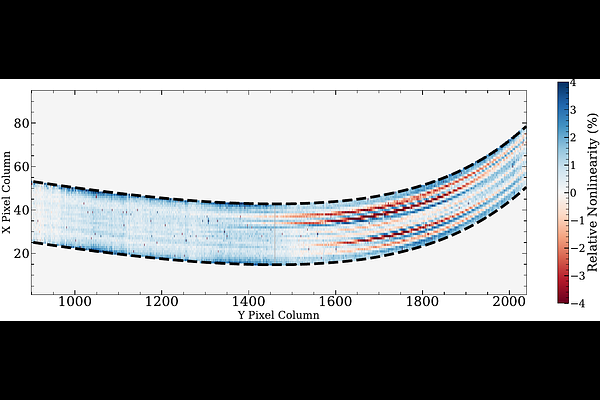
AbstractWe present the first panchromatic JWST transmission spectrum of an ultra-hot Jupiter, combining NIRISS and NIRSpec observations to constrain KELT-7\,b's atmospheric properties. We show evidence for charge migration in our NIRISS SOSS observation between 1--1.5~$μ$m, a wavelength range crucial to test for enhanced H$^-$ previously inferred from HST WFC3/IR G141 observations. We mitigate charge migration by fitting the ramp after extracting 1D stellar spectra at the group level. This ``late-ramp-fit'' method accurately calculates KELT-7\,b's transmission spectrum between 1--1.5~$μ$m at higher signal-to-noise. Using the transit-derived stellar mean density during stellar property inference reveals that KELT-7 is a $640\pm100$ Myr-old, $[\text{Fe}/\text{H}]=0.46\pm0.02$ star. Combined with NIRSpec and re-reduced WFC3/UVIS G280 data, our free retrieval analysis shows strong evidence for H$_2$O, CO$_2$, and TiO among high-temperature species, but not H$^-$ or clouds. Unaccounted-for systematics may therefore bias longer-wavelength WFC3/IR G141 transit depths shallower. Our free retrieval, two equilibrium retrievals, and self-consistent grid fit all prefer a high metallicity but find discrepant C/O ratios. Agglomerated together, we constrain a super-stellar $\text{M/H}=92^{+24}_{-23}\times$~Solar and C/O~$\leq0.9$, suggesting enhanced metal accretion in the later stages of KELT-7\,b's formation. Our GCMs explain the observed lack of limb asymmetry with superrotating jet-driven efficient horizontal mixing. The stark contrast between our panchromatic analysis and prior analyses on subsets of these data demonstrates the value of broad wavelength coverage for the comprehensive study of exoplanet atmospheres.