How well does MAGPHYS recover galaxy properties? A test using EAGLE simulated star-forming galaxies

How well does MAGPHYS recover galaxy properties? A test using EAGLE simulated star-forming galaxies
Zoe R. Jones, Elisabete da Cunha, Andrew Battisti
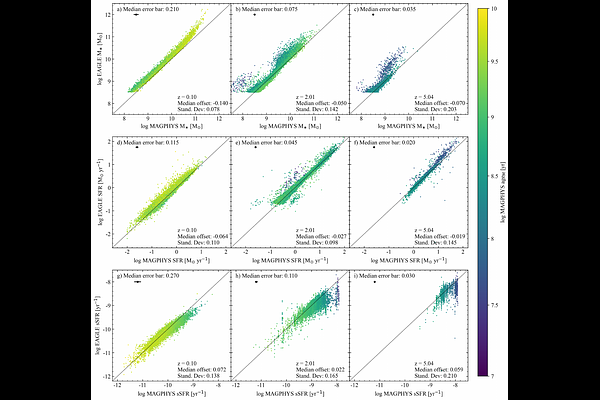
AbstractSpectral energy distribution (SED) models are widely used to infer the physical properties of galaxies from multi-wavelength photometry, but their accuracy is difficult to assess because the true properties of observed galaxies are generally unknown. We address this by fitting synthetic SEDs of ~31,000 star-forming galaxies drawn from the EAGLE cosmological simulations, post-processed with the SKIRT radiative transfer code, using the MAGPHYS SED modelling framework. This provides a controlled testbed with known intrinsic parameters, enabling a direct assessment of model accuracy and the origin of systematic biases. Under idealised conditions, fitting well-sampled ultraviolet-to-submillimetre SEDs at z=0.1, z=2, and z=5, MAGPHYS recovers stellar mass, star formation rate, specific star formation rate, dust mass, and dust luminosity to within <~0.14 dex, while mass-weighted stellar ages are not robustly constrained. We find that mismatches between the assumed star formation history (SFH) priors and the intrinsic SFHs of the simulated galaxies introduce systematic biases in stellar mass estimates, even when the fits provide good statistical agreement. To assess performance under realistic survey conditions, we construct a WAVES-like mock sample using optical and near-infrared photometry with realistic uncertainties. In this case, stellar masses and star formation rates remain well constrained (systematic offsets <~0.1 dex; scatters ~0.07 and ~0.15 dex, respectively), whereas dust properties degrade significantly without far-infrared data: dust luminosities show offsets of ~0.30 dex and scatters ~0.25 dex, and dust masses exhibit scatters ~0.3 dex. We conclude that MAGPHYS is a reliable tool for recovering key galaxy properties from broad-band photometry, but that SFH assumptions and limited wavelength coverage introduce significant uncertainties, particularly for dust and stellar ages.