Future-Interactions-Aware Trajectory Prediction via Braid Theory

Future-Interactions-Aware Trajectory Prediction via Braid Theory
Caio Azevedo, Stefano Sabatini, Sascha Hornauer, Fabien Moutarde
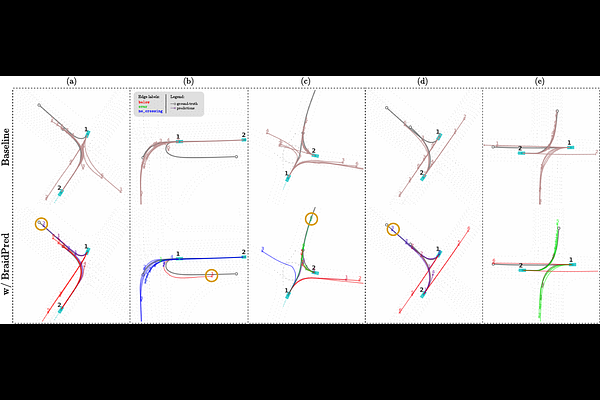
AbstractTo safely operate, an autonomous vehicle must know the future behavior of a potentially high number of interacting agents around it, a task often posed as multi-agent trajectory prediction. Many previous attempts to model social interactions and solve the joint prediction task either add extensive computational requirements or rely on heuristics to label multi-agent behavior types. Braid theory, in contrast, provides a powerful exact descriptor of multi-agent behavior by projecting future trajectories into braids that express how trajectories cross with each other over time; a braid then corresponds to a specific mode of coordination between the multiple agents in the future. In past work, braids have been used lightly to reason about interacting agents and restrict the attention window of predicted agents. We show that leveraging more fully the expressivity of the braid representation and using it to condition the trajectories themselves leads to even further gains in joint prediction performance, with negligible added complexity either in training or at inference time. We do so by proposing a novel auxiliary task, braid prediction, done in parallel with the trajectory prediction task. By classifying edges between agents into their correct crossing types in the braid representation, the braid prediction task is able to imbue the model with improved social awareness, which is reflected in joint predictions that more closely adhere to the actual multi-agent behavior. This simple auxiliary task allowed us to obtain significant improvements in joint metrics on three separate datasets. We show how the braid prediction task infuses the model with future intention awareness, leading to more accurate joint predictions. Code is available at github.com/caiocj1/traj-pred-braid-theory.