A Unified [CII] Morpho-Kinematic Corpus for 31 Star-Forming Galaxies at z = 4.26-5.68: The High-z Kinematic Corpus Z1

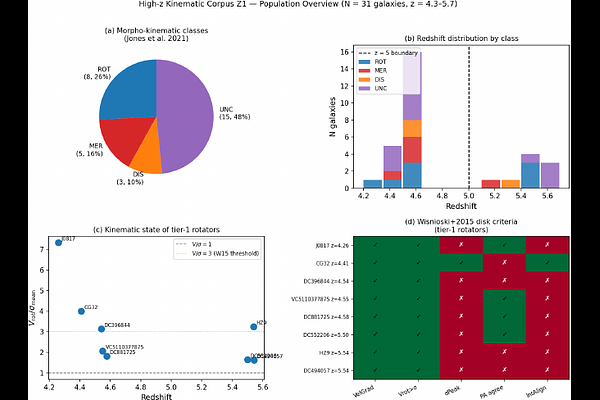
A Unified [CII] Morpho-Kinematic Corpus for 31 Star-Forming Galaxies at z = 4.26-5.68: The High-z Kinematic Corpus Z1
David C. Flynn
AbstractWe present the High-z Kinematic Corpus Z1, a structured machine-readable dataset of ALMA [C ii] 158 um morpho-kinematic data for 31 star-forming main-sequence galaxies at z = 4.26-5.68 drawn from the ALPINE survey (Jones et al. 2021; Le Fevre et al. 2020). The corpus is the fourth entry in the EPS Research RAG Astrophysics Corpus Series, extending coverage from Milky Way globular clusters and local HI rotation curves (Flynn 2026a,b,c) to the epoch approaching cosmic reionization. Eight confirmed rotators carry quality tier 1 per-ring rotation curves from 3DBarolo tilted-ring fits (Di Teodoro & Fraternali 2015), with 2-3 rings per galaxy, Vrot and sigma per ring, and dynamical mass estimates; the remaining 23 galaxies carry morpho-kinematic classification only (quality tier 2). All entries include stellar mass (Faisst et al. 2020), star formation rate, Wisnioski et al. (2015) disk criteria, and geometric parameters. The corpus is distributed as a single structured JSON file with nested per-ring kinematic data, a flat CSV for catalog-level filtering, a RAG-ready JSONL archive (one galaxy per line), and a per-galaxy ZIP archive. Three worked Jupyter notebook examples demonstrate single-galaxy [C ii] rotation curve analysis, corpus-level population statistics, and cross-corpus application of the Flynn & Cannaliato (2025) omega kinematic correction. Applying the omega formula to all 8 tier-1 rotators yields negative values (median -13.05 rad/Gyr), contrasting with positive values at z = 0 (+7.06 rad/Gyr for SPARC spirals; +9.94 rad/Gyr for local dwarfs), consistent with the known evolution from centrally concentrated high-z systems to extended rotating disks. The corpus is publicly available at Zenodo (DOI: 10.5281/zenodo.20369285) under CC BY 4.0.