Reionization Topology as a Probe of Self-Interacting Dark Matter

Reionization Topology as a Probe of Self-Interacting Dark Matter
Zihan Wang
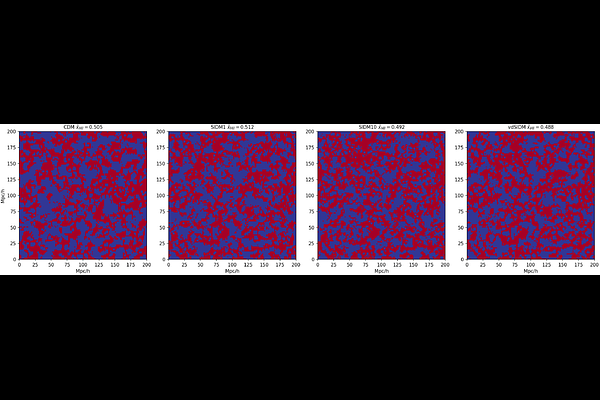
AbstractWe introduce a framework connecting dark matter self-interactions (SIDM) to the large-scale topology of cosmic reionization in this paper. SIDM core formation reduces the gas binding energy in high-$z$ halos, enhancing supernova-driven clearing of ionizing-photon escape channels. We decompose the observable signatures into two scale-dependent levers a percent-level shift in the emissivity-weighted halo bias $b_γ$ that modifies large-scale 21\,cm power, and a factor of 2--4 suppression of emissivity shot noise from increased duty cycles that reshapes intermediate-scale ionization morphology. We derive analytic predictions for the 21\,cm power spectrum ratio and validate them with a halo-by-halo semi-numerical excursion-set framework at $128^3$ resolution where individual halo duty-cycle stochasticity is resolved. For $σ/m = 1$--$10\;\mathrm{cm^2/g}$, we find $\sim 60$--$80\%$ suppression of emissivity shot-noise power, a $12$--$21\%$ reduction in the emissivity variance ratio $\langle \dot{N}^2\rangle/\langle\dot{N}\rangle^2$, and a $50$--$110\%$ increase in the Euler characteristic of the ionization field at fixed $\bar{x}_{\rm HI} = 0.5$. SIDM produces more numerous, more uniformly distributed HII bubbles compared to CDM's topology of fewer large bubbles around rare bright sources. Theintermediate scale signatures are potentially detectable by SKA1-Low in $\sim 1000$ hours. Our results establish reionization topology as a new, complementary probe of dark matter microphysics at mass scales $M \sim 10^{10}$--$10^{11}\,M_\odot$ and redshifts $z \sim 6$--$10$.