Insights into the Exoplanet Radius Valley from Host-Star Ages, Activity, Chemistry, and Birth Radius

Insights into the Exoplanet Radius Valley from Host-Star Ages, Activity, Chemistry, and Birth Radius
Xunzhou Chen, Tiancheng Sun, Yuxi, Lu, Zixuan Lu, Lifei Ye
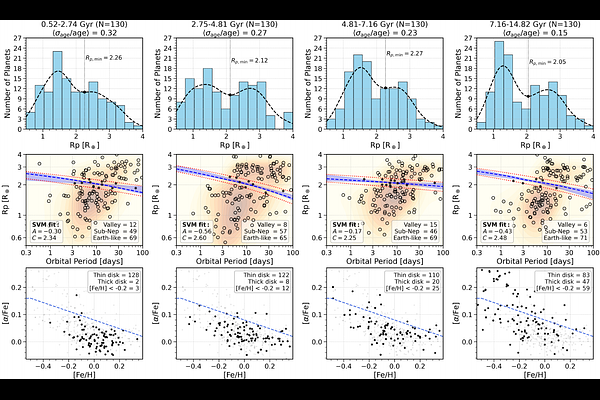
AbstractThe radius valley, a bimodal feature in the size distribution of close-in small exoplanets, is widely interpreted as a signature of atmospheric loss and therefore provides a key constraint on the formation and atmospheric evolution of these planets. We investigate its dependence on host-star properties using 769 planets orbiting 558 stars, for which we derive stellar ages, chromospheric activity, and Galactic birth radius, together with elemental abundances. We find that the radius valley is not fully established at ages $\sim 3$ Gyr and evolves over gigayear timescales, with its prominence strongly affected by stellar population mixing. The dependence on magnetic activity is non-monotonic: a clear valley is present even among magnetically quiet stars, while highly active systems do not show a systematically stronger depletion. The valley morphology also varies with stellar composition: the valley is strongest in metal-poor stars, weakens near solar metallicity, and partially strengthens again at the highest metallicities. In addition, the valley shows sensitivity to refractory element ratios such as [Mg/Si], while correlations with [C/O] are weaker, indicating a dependence on planetary interior structure. Our results are more consistent with a dominant role for core-powered atmospheric mass loss than with purely irradiation-driven photoevaporation. Finally, the radius valley also depends on the Galactic birth environment, with systems near the estimated solar birth radius $\sim 4.5$ kpc showing a high fraction of Earth-like planets and a well-defined bimodal structure, suggesting that the Solar System formed in a region with a well-developed Earth-sized planet population.