Iron isotope anomalies and the origin of the Earth

Iron isotope anomalies and the origin of the Earth
Timo Hopp, Shengyu Tian, Thorsten Kleine
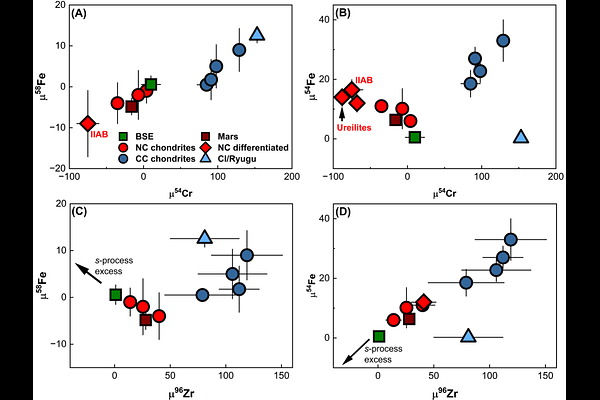
AbstractUnderstanding the origin of the Earth requires determining the original formation location of its building material. Based on the similar Fe isotopic composition of Earth's mantle and Ivuna-type (CI) chondrites, a prior study has argued that Earth formed by accretion of sunward-drifting pebbles from the outer Solar System. Here, using new high-precision Fe isotopic data, we show however that CI chondrites and Earth's mantle have distinct Fe isotopic composition when the neutron-rich 58Fe is also considered. This observation rules out that the Fe in Earth's mantle derives from CI chondrite-like material and demonstrates that Earth did not form by accretion of sunwards-drifting pebbles. We show that the Fe in Earth's mantle instead derives from the inner Solar System, and has been partly or wholly delivered by bodies from the innermost disk that remained unsampled among meteorites. This provenance of terrestrial Fe is consistent with the classical model of Earth's formation by hierarchical growth among inner Solar System planetesimals and planetary embryos.