Gravitational Wave Propagation in K-essence Cosmology: Theory and Observational Constraints

Gravitational Wave Propagation in K-essence Cosmology: Theory and Observational Constraints
Sougata Bhunia, Eduardo Guendelman, Debashis Gangopadhyay, Ramón Herrera, Abhijit Bhattacharyya, Goutam Manna
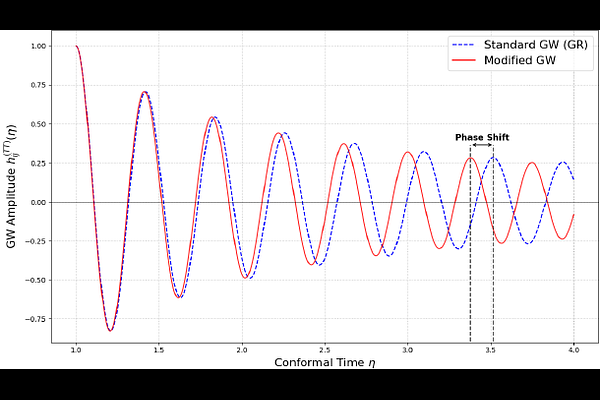
AbstractGravitational waves (GWs) provide a powerful, theory-independent probe of the dynamical structure of spacetime and the cosmological background. We study linearized GW propagation in k-essence cosmology, where a non-canonical scalar field describes the dark sector. In the high-frequency (short-wavelength) approximation on a Friedmann--Lemaître--Robertson--Walker (FLRW) background, and restricting to the transverse-traceless tensor sector, we derive a modified evolution equation for tensor perturbations. The GW speed remains strictly luminal, consistent with multimessenger bounds such as GW170817, but the interaction with the background field $\barφ$ induces a time-dependent effective mass-like term $m_{\rm eff}$. This background-induced mass modifies the dispersion relation without introducing additional propagating degrees of freedom, leading to a cumulative, frequency-dependent phase shift in the waveform over cosmological distances. We show that $m_{\rm eff}$ is uniquely determined by background cosmological parameters and can be written as a redshift-dependent function, $m_{\rm eff}(z)$, directly linking GW observables to scalar-field dynamics, while the GW luminosity distance remains identical to its electromagnetic counterpart, preserving standard-siren consistency. We test the scenario through a joint Bayesian analysis that combines cosmic chronometers (CC), BAO, Pantheon+SH0ES, and standard-siren data from GWTC-2.1/3/4. The reconstruction is consistent with current constraints and reproduces the late-time expansion history, while the evolution of $m_{\rm eff}(z)$ offers a new mechanism that may help alleviate the $H_0$ tension.